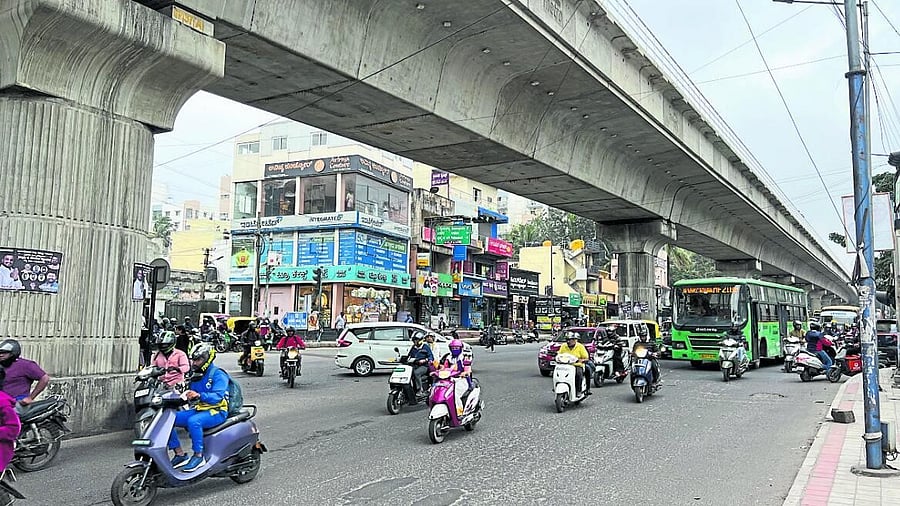
While the GBA claims that 95% of the work was completed at the junction, no major improvements were seen at Arakere Junction.
Credit: DH Photo/ Asra Mavad
Bengaluru’s traffic junctions are where the city’s rapid growth collides daily with outdated planning. From endless signal waits and chaotic merges to pedestrians stranded between lanes, these intersections reveal the stress points of an expanding metropolis.
As vehicle numbers soar and road space remains finite, poorly designed junctions amplify congestion, fuel wastage, and accident risk. Improving them is no longer about convenience alone — it is about safety, productivity, and quality of life. And rightly so, these junctions are currently a major point of focus for the Greater Bengaluru Authority (GBA).
Earlier this month, GBA Chief Commissioner Maheshwar Rao instructed officials to expedite the ongoing development works under the Suraksha 75 Junctions initiative across the GBA limits.
What is Suraksha 75?
An ambitious project launched by the erstwhile BBMP in 2023, Suraksha 75 is a road safety and junction-revamp initiative. Launched in the 2023–24 Karnataka budget, it targets the redesign and upgrading of 75 major traffic junctions to make them safer, more efficient and more accessible for pedestrians, cyclists, and motorists.
Some of the features of the initiative include improved road geometry, safer pedestrian crossings, traffic-calming measures, better walkways and signage, and overall traffic congestion reduction. The project works with partners such as the World Resources Institute (WRI) India through global road safety programs. It is funded by a significant city budget allocation of approximately Rs 100 crore, which is likely to overshoot.
Lost in translation
However, the project, which started slowly, remains stuck in the process of finalising geometry and design.
A progress report shared by the GBA in October stated that of the 28 junctions where the work is currently in progress, 90-95% of the work has been completed at the following locations: Arekere, Sarakki, Kudlu Gate, Hogasandra Metro Station, Manipal County (Hosur Road), Garebavipalya Temple in Bommanahalli, Tin Factory, Benniganahalli, KR Puram, and Ballari-Palanahalli Road. GBA data showed that only the improvements at the Horamavu bridge junction are 100% complete.
However, the reality on the ground did not match the data. A visit by DH to some of the aforementioned junctions, such as Arekere, Tin Factory, Yelahanka, and KR Puram, left one wondering what changes had been made under the initiative. Most junctions remained in poor condition, with haphazard traffic flow and limited pedestrian mobility.
The new City Corporation Commissioners have once again been instructed to conduct a field study and prepare a new progress report, a senior GBA official shared.
“We realised that a lot had been lost in translation — at first, when divisions within BBMP were moved about and then later when BBMP transitioned into GBA. With engineers and teams involved in Suraksha 75 constantly changing, we noticed that the progress report did not match the ground reality in many areas. Now each corporation is undertaking a reality check of what needs to be done within its jurisdiction,” she told DH.
In Bengaluru East, the junctions currently in focus are Kundahalli, Tin Factory, KR Puram, and Marathahalli, among others, shared Lokhande Snehal Sudhakar, Additional Commissioner (Development), East City Corporation.
“We have also identified eight junctions on the Outer Ring Road (ORR) that need improvement. These are in the planning phase. We have already instructed our engineers and are in the process of appointing urban transport planners and designers. A tender has been floated for the roles. This is our top priority right now,” he said.
Officials from North, West, Central, and South Corporations did not respond to DH’s calls.
Meanwhile, GBA Chief Commissioner Maheshwar Rao has set March 2026 as the deadline for completing the Suraksha 75 project.
“Each corporation is individually working on junctions in its jurisdiction, and we’re guiding them along the way,” he said, adding that some junction improvements will be implemented in Hebbal on a trial basis soon. He has asked the corporations to undertake continuous monitoring, conduct corporation-wise review meetings, and regularly submit progress reports.
Need for improvement
A common misconception among city planners and organisations involved in planning is that a junction can aid decongestion, believes V Ravichander, an urban expert based in Bengaluru.
“Fixing a junction will not improve the overall traffic situation in a locality. It will just shift the congestion from one point to another. Unless you address the overall traffic movement network, you won’t find a solution. These changes need to be data-driven and scientific in nature,” he said.
For ongoing junction improvement projects, he stresses the importance of providing a ‘free left’ wherever possible. “When you’re cleaning up the road geometry, which is the most essential step of improving a junction, wherever possible, a free left must be provided. A two-lane road needs to be expanded to three lanes so the third lane can merge into the slip road and take the left lane. This will help improve traffic flow. For this, the authorities will need to do strategic land acquisition,” he said, adding that equal importance needs to be given to pedestrian movement.
“The notion that the road belongs solely to motor vehicles is wrong. Skywalks are not the solution for pedestrian movement. They don’t belong in most of the smaller roads where they’re being built,” he added.
Proper channelisation from all directions at the junction needs to be prioritised, according to Prof. Ashish Verma, the convenor of the IISc Sustainable Transport Lab.
“For this, all you need are simple, scientifically designed channelising islands. We’ve tried this at CNR Rao Circle, and it’s been working great. It has not only improved traffic flow but also made it safer. Along with this, these also serve as refuge islands for pedestrians and cyclists,” he said.