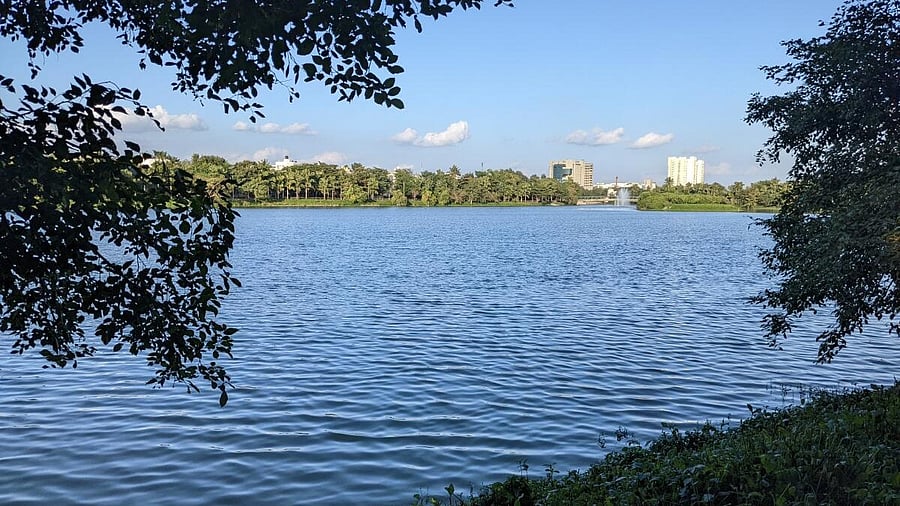
One of Bengaluru's most poetic secrets lies in the suffix 'sandra' as in Allasandra lake.
Credit: Udaya Kumar P L
When you drive down the leafy avenues of Bengaluru or take a Metro ride across the city, you are not merely commuting — you are moving through a living history book. You have probably glanced at the signboards — Koramangala, Sunkadakatte, Pattandur — without a second thought. To the average Bengalurean, these are just GPS pins or the names you mutter while cursing our daily commute woes.
But if you pause and look closer, these names reveal themselves as time capsules.
They are not random sounds, but echoes of a city that was a centre of scholarly institutions, vast water bodies, military camps and bustling trade hubs even centuries ago.
First, let us settle one thing: Bengaluru is not new. While the shiny glass facades of Whitefield may look modern, the ground beneath them is ancient.
Evidence of this past survives at the Panchalingeshwara Temple in Beguru (Begur), where an inscription carved into stone and dating back to 890 CE records a battle fought in a place called “Benguluru.”
A city of ‘hallis’
Bengaluru is often imagined as one single, massive city, but the suffix -uru reveals that the city is actually a massive patchwork. In Kannada, uru or pura means a town or large settlement.
Bengaluru is, in fact, stitched together from nearly 200 ancient, independent uru-puras such as Dombalur (now Domlur), Varthur, Yadiyuru, Yeshavantapura, and a staggering 450 hallis (villages) such as Akkithimmanahalli, Harohalli, Yelachenahalli and Shivanahalli.
Centuries before the Outer Ring Road linked them, these were self-sufficient towns with their own chieftains and temples. To live in an uru today is not just to occupy a neighbourhood — it is to inhabit a historical town that has preserved its identity across centuries.
Centres of learning
Bengaluru’s status as an education hub today is rooted in a tradition that records show is centuries old. The proof is in the names ending with ‘Agrahara’ or ‘Mangala’.
In ancient times, kings, chieftains and merchants would grant entire villages to learned scholars to set up centres of worship and learning. These settlements, called Agraharas and Mangalas, were the medieval equivalent of residential university campuses.
They housed people of all communities while learning was mostly limited to Brahmins. There is a mention of around 45 Agraharas and Mangalas (auspicious towns) in the records.
So, remember, when you drive through Roopena Agrahara or Sarakki Agrahara or Koramangala, you are driving through the “IIMs” and “IIScs” of the past. In an amazing twist of irony, the Bengaluru jail today, located at Parappana Agrahara, continues this legacy as a place for “relearning” and correction.
The original social network
Long before Facebook groups or WhatsApp chats, Bengaluru had the kattes.
A katte is a raised platform, usually built around a massive peepal or banyan tree. It served as the village parliament, the gossip corner and a resting place for travellers.
Bengaluru’s locality records are full of them — Sunkadakatte (the toll platform) and Aralikatte (the peepal tree platform), to name a few.
Imagine Sunkadakatte centuries ago: a bustling checkpoint where traders halted their bullock carts, paid a small toll (sunka), and sat beneath the tree to exchange news. It was, in many ways, the city’s original social network.
One of the city’s most poetic secrets lies in the suffix — sandra — as in Thippasandra, Bommasandra or Jakkasandra. It comes from samudra, meaning ocean. Bengaluru, of course, had no sea, but our ancestors used this grand word to describe the vast lakes they built. Every sandra is a memory of a shimmering, life-giving “ocean” that once cooled the city.
The ‘palyas’
Moving from water to barracks, we encounter the palyas. Unlike the agricultural hallis, the suffix palya often hints at a military past, tracing back to the 18th century reigns of Hyder Ali and Tipu Sultan. These were often camps for soldiers or specialised workers. Sultanpalya, for instance, echoes the ruler’s regiment, while Kalasipalya was historically home to the kalasis, tent-pitchers and camp followers who were the backbone of an army on the move. These localities, today, stand as living reminders of the hands that built and safeguarded Bengaluru.
Many markets
Finally, the city’s prosperity is etched into its petes — the markets. Kumbarpete is the potters’ market. Tigalarapete takes its name from the Tigala community, custodians of the Karaga festival. Historically, they were expert gardeners and were responsible for many of Bengaluru’s famous gardens.
Upparapete was the salt sellers’ market, while Ganigarapete was the oil-pressers’ market.
These names are a salute to the dignity of labour. They remind us that Bengaluru wasn’t built by kings alone — it was built by potters, weavers, salt-sellers and gardeners.
And to keep the city fragrant, there were the thotas or gardens. Mallige Thota, a jasmine garden, and Attiguppe, a grove of fig trees, evoke a time when the air was filled with the scents of flowers.
So, the next time you glance at a signboard, remember that it points not just to a place, but to a past. Whether you are in an uru (a town), a palya (a military camp) or a pete (a market), you are standing on stories that span centuries.
The glazed high-rises may be new, but the soul of the city is ancient, warm and very much alive.
(The author is the Honorary Project Director of The Mythic Society, Bengaluru))