
Credit: Special arrangement
The Constitution has granted all citizens the freedom to express their opinion. Article 19(1)(a) refers to freedom of speech, which allows every citizen of India to express, speak and write about their opinions.
Several courts and constitutional experts have articulated that freedom of speech includes listening to the opinion of others, differing with someone else’s opinion, obtaining information and having the right to question. Freedom of speech is immortalised in 18th-century French philosopher Voltaire’s words: “I disapprove of what you say but will defend to the death your right to say it.”
Dance, drama, singing, street play, cinema, serial, photography, painting, literature, criticism… all this come under freedom of expression.
However, freedom of speech granted by the Constitution is not absolute. It has restrictions, where any speech hinders the security, sovereignty and unity of the nation, relationship with friendly nations, law and order and defames another person is not permissible. Article 19(2) states that the government should frame adequate laws to protect this.
In India, restrictions on freedom of speech began during the British era itself. To suppress freedom fighters, the British introduced laws on sedition (Section 124 A of the Indian Penal Code). Having undergone such suppression, our Constitution makers have ensured that we have the freedom of speech. The state is retaining these laws while regulating freedom of speech.
In the United States, freedom of the press and freedom of the speech are different. However, India doesn’t have a separate concept of freedom of the press. The Supreme Court has interpreted that freedom of speech includes freedom of the press. As a result, the media also comes under the ambit of freedom of speech.
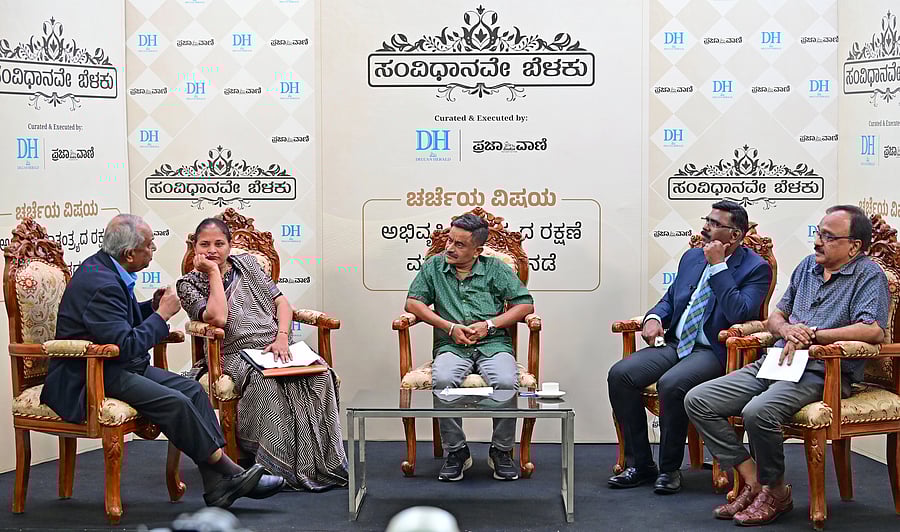
Deccan Herald, Prajavani and the Social Welfare Department jointly organised a discussion on ‘Speech, freedom, state and Constitution’ in Bengaluru.
In a debate on “Constitution is light: A discussion,” experts from different fields participated. Retired High Court Judge H N Nagamohan Das, Prof Nataraj Huliyar from Bangalore University’s Kannada Study Centre, the then Social Welfare Department principal secretary Captain P Manivannan and Senior High Court advocate Manjula Devi were among those who participated in the debate, which was compered by Prajavani’s chief reporter Y G Jagadish.