
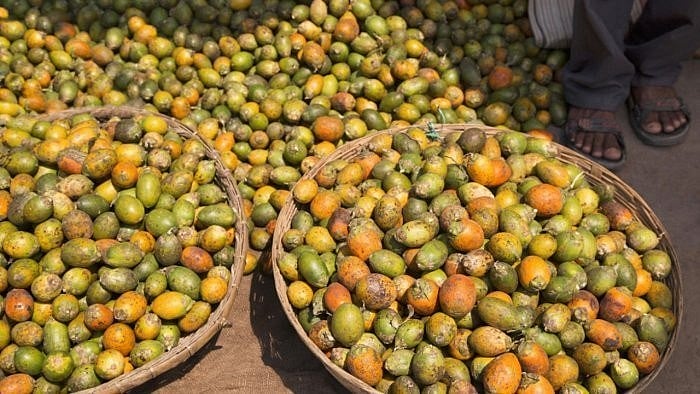
File image of arecanut.
Credit: iStock Photo
New Delhi: Dakshina Kannada MP Captain Brijesh Chowta on Monday urged the Centre to immediately ban duty-free import of arecanut from Least Developed Countries (LDCs) such as Bhutan, Myanmar and Sri Lanka.
Raising the issue in Lok Sabha, he said that large-scale arecanut imports from Least Developed Countries (LDCs) such as Bhutan, Myanmar and Sri Lanka have been adversely affecting India’s domestic arecanut market, severely impacting farmers in key producing regions, mostly Karnataka.
These countries currently enjoy zero customs duty under India’s Duty-Free Quota-Free (DFQF) preferential trade scheme — a provision originally intended to support LDC economies but now being "misused" in a way that harm Indian farmers. The zero-duty window has resulted in low-cost, inferior-quality arecanut flooding the Indian market, destabilising prices and pushing cultivators into distress, he said.
The normal arecanut imports attract 100 per cent basic customs duty, but the DFQF exemption nullifies this protection entirely. This loophole has led to price crashes, market instability and deep economic anxiety among lakhs of cultivators whose livelihoods depend on the crop, he said.
Between September 2023 and August 2024, Bhutan accounted for 57 per cent of all arecanut import shipments, followed by Myanmar at 39 per cent and Sri Lanka at around 2 per cent, he said.
India is fully self-sufficient in arecanut production, having produced around 14 lakh tonnes nationally in 2023–24, with Karnataka alone contributing nearly 10 lakh tonnes. Yet, despite this domestic abundance, large volumes of zero-duty imports continue to enter the country, creating a steep and unfair price disparity that erodes the competitiveness of farmers in major growing regions such as Dakshina Kannada, Shivamogga, Udupi and Chikkamagaluru, he said.
Reports indicate that India imported approximately 30,271 tonnes of arecanut during the first eight months of the 2023–24 fiscal year (April–November) — a volume that stands in stark contrast to domestic production and signals an avoidable reliance on imports despite clear self-sufficiency.
He emphasised that while India remains committed to supporting LDC economies, such concessions must not compromise the economic security of Indian farmers.