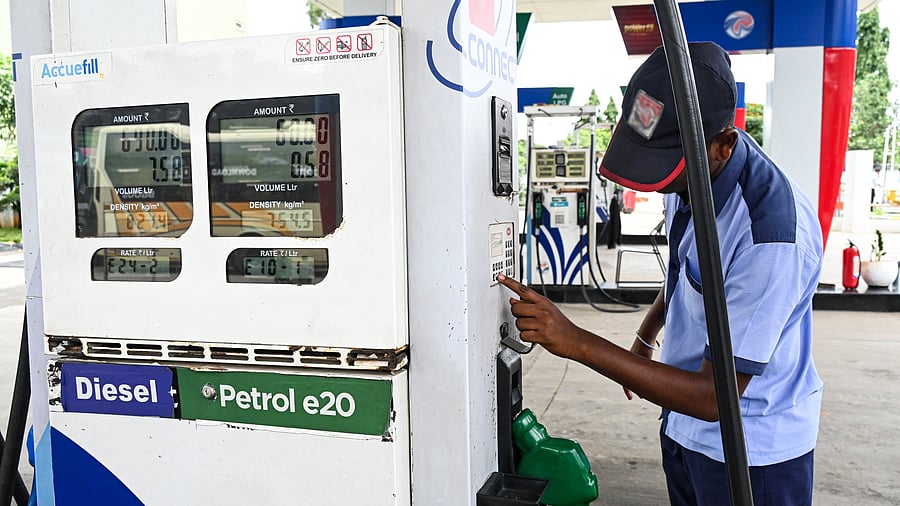
Representative image of a fuel station selling E20 petrol.
Credit: DH Photo
Hubballi: Use of ethanol blended petrol (EBP) in motor vehicles won’t have any negative impact on vehicle compatibility, any significant variations in the performance or show any abnormal wear-and-tear of the vehicle, says Ministry of Petroleum & Natural Gas
In a written reply to Rajya Sabha the ministry stated that the oil manufacturing companies and government of India after noticing certain media reports and social media posting concerns relating to the use of E20 fuel constituted an inter-ministerial committee to examine various aspects of the vehicle compatibility and mileage.
The research studies conducted by Indian Oil Corporation Limited (IOCL), the Automotive Research Association of India (ARAI), and the Society of Indian Automobile Manufacturers (SIAM) after conducting extensive field trials on vehicles with E20 fuel did not indicate any compatibility issue or any negative effect.
Experts and the general public have been often highlighting that use of ethanol as fuel reduces the efficiency as the majority of the vehicles are not compatible with the blending. They state that along with a drop in mileage, the use of EBP could also result in recurrent cost of repairing the spares and affect the longevity of the vehicle.
However, the government and agencies have refuted the claims. “Even legacy vehicles do not exhibit any significant variations in performance, nor do they show abnormal wear-and-tear when operated with E20 fuel. No issues were reported in parameters such as drivability, steerability, metal compatibility, and plastic compatibility,” says the reply.
The report from ARAI, SIAM and Federation of Indian Petroleum Industry states that use of E20 fuel gives better acceleration, better ride quality and most importantly, lowers carbon emissions by approximately 30% as compared to E10 fuel. “Ethanol’s higher heat of vaporization reduces intake manifold temperatures, increasing air-fuel mixture density and boosting volumetric efficiency,” it says.
Deepak Ballani, Director General of the Indian Sugar & Bio-Energy Manufacturers Association (ISMA), says Indian vehicles have been voluntarily ethanol compliant since 2009. “So far none of the IOCs or vehicle manufactures have raised any complaint regarding the malfunctioning of the vehicles after using ethanol blended fuel. Multiple industries are conducting research and studies on the efficiency and none have given any negative feedback,” he says and adds there could be slight dip in the millage (2% to 4%). “If a car was clocking 15 km per litre of petrol, then E-20 blended fuel could give 14.8 km per lt. This is negligible given the multiple benefits it is providing directly to farmers and foreign exchange,” he says.
Government claims that Ethanol Blended Petrol (EBP) Programme has resulted in farmers receiving a payment of Rs 1.36 lakh crore from supply of ethanol between 2014-15 and October 2025. The government has also been able to save Rs 1.55 lakh crore of foreign exchange due to blending of ethanol extracted from sugarcane and other food grains. The government also states that use of E10 and E20 has resulted in reducing approximately 790 lakh metric tons of carbon dioxide and 260 lakh metric tons of crude oil.
As of October India has achieved an average blending of 19.97% ethanol in Petrol. In the next decade it wishes to blend 30% of ethanol in Petrol.