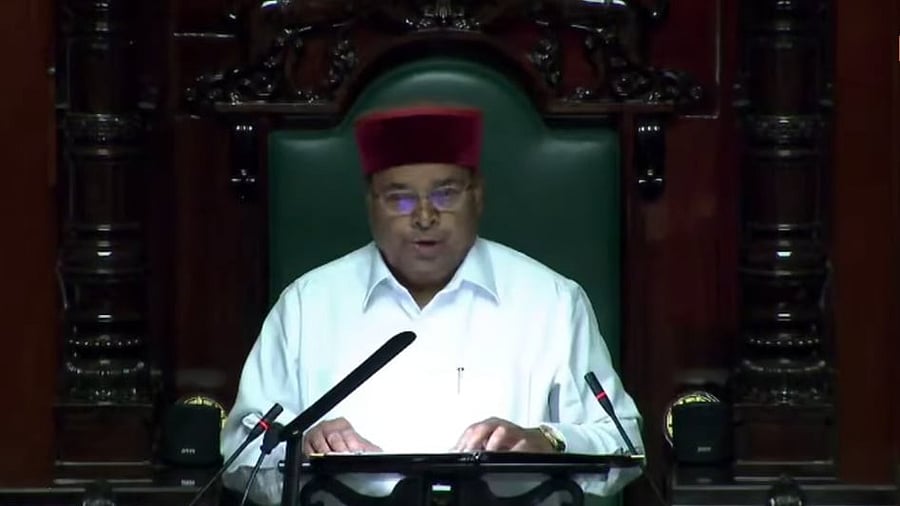
Governor Thaawarchand Gehlot
Credit: Youtube/Doordarshan Chandana
Bengaluru: Governor Thaawarchand Gehlot has decided to send the Karnataka Hate Speech and Hate Crimes (Prevention) Bill, 2025 (Karnataka Bill No 79/2025) to the President.
Confirming the development to DH, sources in the government said that the governor has raised several objections to the bill, besides citing various judgments on the subject.
The sources added that the governor was of the opinion that the issue needed to be further deliberated upon. Citing a Supreme Court judgement dated November 20, 2025, the governor has pointed to the discretion he enjoys under Article 200.
“I am hereby exercising the powers under Articles 200, 201 and 254 of the Constitution of India to reserve the subject Bill LA No. 79/2025 — The Karnataka Hate Speech and Hate Crime (Prevention) Bill, 2025 — for the kind consideration and assent of Her Excellency, the President of India,” the governor has said, according to the sources.
The sources said that the issues dealt with in the Bill have been widely discussed in print and electronic media, and 40 representations were received urging the governor to withhold assent.
“There is no doubt that hate speech is harmful to society. But killing freedom in the name of preventing hatred is not the solution. In a free society, the answer to hatred should be free speech and not dictatorial laws. Education, culture and awareness should be used to combat hate speech,” the governor observed, the sources said.
He reportedly cited three key constitutional concerns: possible repugnancy with Central laws under Article 254, potential violation of fundamental rights under Articles 14, 19 and 21, and what he described as subjective and draconian executive powers in the proposed legislation.
A major point of concern was the definition of “hate speech” in Section 2(1) of the Bill. It defines hate speech as any expression — spoken, written, visual or electronic — made with the intention of causing harm, disharmony, hostility, hatred or ill-feeling against any person, living or dead, or any group or community. The governor is understood to have expressed apprehension that such a broad definition could lead to ordinary or spontaneous speech being criminalised. He also stressed that police must act impartially and cautiously while exercising powers under the proposed law and suggested that wider consultation with all sections of society would have strengthened the process.
Among the issues flagged were vagueness, overbreadth and the potential chilling effect on free speech under Article 19(1)(a), as well as concerns over proportionality and procedural safeguards under Articles 19 and 21. He emphasised that democracy depends on freedom of expression, respect for differing opinions and open dialogue. The Bill’s ambiguities and long-term impact on democratic discourse, he suggested, warrant careful scrutiny by the intellectual community. He further noted that any criminal law must ensure legal certainty so citizens clearly understand what constitutes an offence.