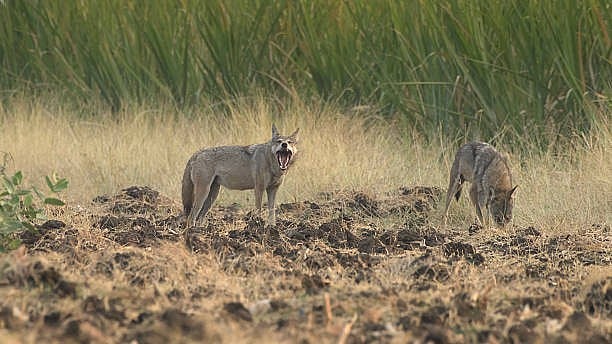
Experts fear the continuation of this trend could intensify conflict between wolves and farmers. Credit: iStock
Hubballi: Wolves in Koppal’s Yelburga taluk have developed a liking for watermelons and have begun raiding fields where the fruit is cultivated.
Though wolves are known to be occasional consumers of watermelons — mainly for hydration and certain minerals — experts in Koppal say the canines are now feeding on the fruit regularly.
They suggest two possible reasons for this change in wolves’ food habits: declining prey base and change in habitat, as dry and barren grasslands are being converted into seasonal watermelon cultivation areas, resulting in easy access to the fruit.
Experts fear the continuation of this trend could intensify conflict between wolves and farmers. Currently, wolves face threats from shepherds, as nearly 90% of their prey consists of sheep and goats, belonging to these pastoral communities.
Deccan Conservation Foundation founder-president Indrajeet Ghorpade says over the past decade there has been a noticeable increase in incidents of wolves feeding on watermelons.
Cultivation area up
“Earlier, watermelon was grown in small patches. But, with an increase in borewell irrigation, watermelon growing area has expanded. Earlier, a pack of four or five wolves would consume one or two watermelons in a day. Today, we are witnessing the same number of wolves consuming and damaging 10–15 watermelons in a single night,” he says.
His team, which has been studying the grassland species of Koppal region for over four decades, says wolves seem to have developed a preference for the fruit, leading to regular raids during the season.
Ghorpade says the wolf habitat in Yelburga is undergoing drastic changes due to the rise of windmills in rocky terrain and expansion of agricultural land.
This has resulted in a decline in prey base of wolves like blackbuck and chinkara.
“Although wolves continue to prey on sheep and goats, we are observing that watermelon has also become a regular part of their seasonal diet,” he says, adding consumption of watermelons could be a survival strategy and part of the species evolving in response to changes in habitat. He says his team has observed wolves feeding on other fruits as well like Indian jujube (‘bare’ in Kannada) and custard apple.
Honnavalli N Kumara, principal scientist at Salim Ali Centre for Ornithology and Natural History, who has conducted studies on wolves, said: “Meat remains the essential and necessary food for wolves. There have been incidental records of wolves eating watermelons. But if they are feeding on this fruit regularly, it indicates a lack of natural prey for the predator. Wolves are forced to consume alternative foods when availability of blackbuck, chinkara or livestock like sheep is low”.