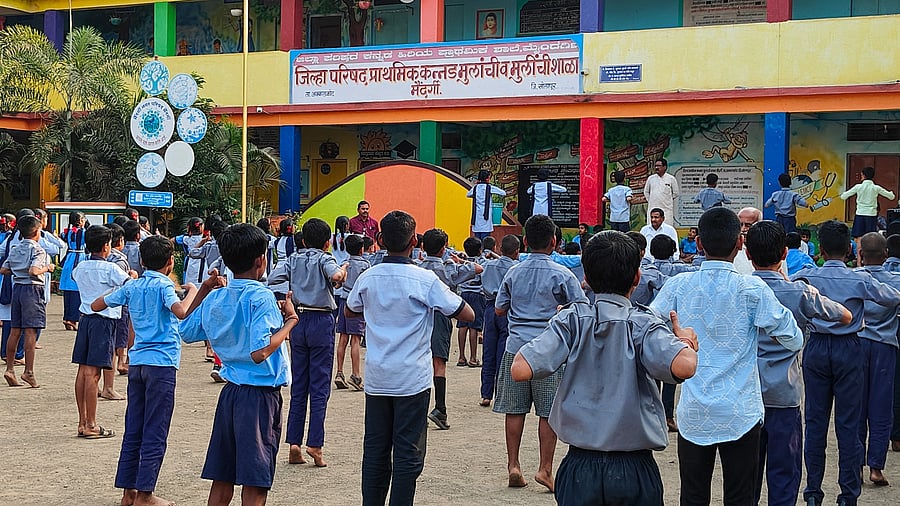
Over 1 lakh students in six states bordering Karnataka are enroled in Kannada-medium schools. In pic, students participate in an activity at the Zilla Parishad Kannada Medium School in Maindargi, a border village in Akkalkot taluk, Maharashtra.
Credit: DH Photo/Vittal Shastri
Once bustling with activity, classrooms in a Kannada-medium government school in Kerala’s Kasaragod have fallen unusually quiet over the past fortnight, reflecting the mood across Kannada-medium schools in the district. While most students remain largely unaware of developments beyond the school’s walls, a sense of unease has begun to take hold among teachers and senior students.
“Everyone in our school says Malayalam will be made compulsory. If that happens, I may have to stop learning Kannada as my first language and start learning Malayalam from scratch,” says Priya (name changed), a Class 5 student.
Despite clarifications from the Kerala government regarding the proposed Malayalam Language Bill, 2025, which seeks to make Malayalam the compulsory first language from Classes 1 to 10 in all government and aided schools across the state, including Kannada-medium schools in border districts such as Kasaragod, doubts persist among students, teachers and the Kannada-speaking community. Kerala Chief Minister Pinarayi Vijayan has clarified that the proposed Bill does not impose Malayalam, allows non-Malayalam students to choose other languages under the national curriculum, and exempts them from Malayalam exams at higher levels. Yet Kannadigas remain unconvinced that linguistic minorities will be unaffected by the proposed changes. For Akshatha (name changed), a Class 10 student at an aided school in Kasaragod district, Kannada is not merely a subject in her timetable.
“Kannada is the language through which I think and express myself. Forcing another language on us will only create stress. There is a stark difference between learning by choice and learning under compulsion,” she says.
Apprehensions of Priya and Akshatha are rooted in their past experiences. According to reports, a few years ago, Kerala government appointed Malayalam-speaking teachers to Kannada-medium schools in Adoor, Bekur, Mangalpady and Paivalike in Kasaragod district. The government revoked the appointments and appointed Kannada-speaking teachers only after stiff resistance from Kannadiga parents, students and teachers. According to a retired headmaster, many parents believe their children cannot survive in Kerala without Malayalam and therefore prefer enroling them in Malayalam-medium schools instead of Kannada-medium ones, which they themselves had attended. As a result, the enrolment in Kannada-medium schools has declined drastically over the years.
Teachers note that Malayalam is being taught to interested students in lower primary schools through teachers appointed using the Zilla Panchayat fund.
Articles 29, 30 and 350A of the Constitution guarantee over one lakh students studying in Kannada-medium schools in six neighbouring states of Karnataka the right to education in their mother tongue. Yet, experts argue that these protections largely remain on paper. Kerala is not alone, even in states such as Tamil Nadu, Andhra Pradesh, Telangana, Maharashtra and Goa, Kannada-medium education has been affected in various ways.
Critics note that successive governments in Karnataka have made limited efforts to instil a sense of belonging among Gadinadu Kannadigas (border area Kannadigas) and Horanadu Kannadigas (a Kannada-origin population settled outside the state), and provide them with opportunities that could inspire future generations to sustain Kannada not merely as a medium of instruction, but as a source of pride.
Poor infrastructure in Kannada-medium schools, a shortage of qualified teachers, unfavourable language policies and above all, fear of limited educational and career prospects after Class 10 have prompted parents to avoid enroling their children in Kannada-medium schools outside Karnataka.
Shankar Halagatti, general secretary of Karnatak Vidyavardhaka Sangha in Dharwad, says, “Mother-tongue education is the bridge connecting Kannada-origin communities outside the state to Karnataka’s culture. If even one generation is deprived of education in Kannada, the language could vanish from these regions forever.”
Data from the Karnataka Border Area Development Authority (KBADA) shows that as of December 2025, there are 654 government and aided Kannada-medium schools across six neighbouring states with around 1.10 lakh students studying in them. Officials and activists in these border regions say that the number of Kannada-medium schools has declined sharply over the past two to three decades. Meanwhile, the Karnataka government does not have authentic records on how many Kannada-medium schools have closed outside Karnataka since the linguistic reorganisation of states in 1956.
Two language policy
In Tamil Nadu, Hosur district now has five Kannada-medium primary schools. Sanjeev M, former member of the Kannada Sahitya Parishat (Tamil Nadu unit), recalls that six decades ago, Hosur had at least 24 primary and high schools.
“Tamilians are very proud of their language, which is understandable. But over the years, Tamil Nadu’s two-language policy has had an impact on Kannada-medium schools. As enrolment declined, several schools were forced to close, and today only a few remain.”
Maharashtra has the highest number of Kannada-medium schools outside Karnataka, with 377 schools educating around 44,860 students. In 2024, a controversy arose after Marathi-speaking teachers were appointed to Kannada-medium schools in Solapur district.
Belagavi-based activist Ashok Chandargi calls it a deliberate attempt to weaken Kannada education. “The government is failing to appoint Kannada teachers and denying adequate funds to improve infrastructure and supply study materials. This is pushing students towards Marathi or English-medium schools,” he says.
In Akkalkot taluk of Solapur, Kannada schools are witnessing a concerning trend: parents send girls to Kannada schools but boys to English or Marathi schools for a “better future.”
Gurubasappa Hasaramani, a teacher at Gandhi Nagar Kannada Primary School in Dudhani village in Solapur district, says teachers visit houses for nearly two months before the academic year to persuade Kannadiga parents to enrol their children in Kannada schools. “We distribute school bags, notebooks and other materials, often using our own salaries. Despite this, enrolment has dropped from 120 students a decade ago to just 53 this year.”
“Girls are often sent to Kannada schools so that they can 'adjust' in their in-law’s homes in Karnataka,” he says.
Another hurdle is that competitive examinations for higher education and employment are conducted in the host state’s language, even for positions in Kannada-medium schools. For instance, in Maharashtra, aspiring teachers must clear the Maharashtra Teachers Eligibility Test (MahaTET), which is conducted only in Marathi. “Teachers who wish to serve in Kannada-medium schools struggle with Marathi question papers,” says Mahesh Gayakwad, head of the Dudhani cluster, which comprises 18 Kannada-medium schools.
“Despite repeated appeals to conduct the test in Kannada for core subjects like mathematics, social studies and science, the Maharashtra government has taken no action,” he explains.
He adds that this policy has had a severe impact, with student strength halving over the past decade. Interestingly, while Kannada-medium schools are declining in Maharashtra, Marathi-medium schools in Belagavi and Khanapur are seeing rising enrolment.
“There are 38 villages in Karnataka without a single Kannada-medium school but with Marathi-medium schools. If we cannot protect Kannada within our own borders, how can it be protected outside?” Chandargi points out.
“The Maharashtra government is expanding its educational footprint in Karnataka, offering Marathi-medium students benefits such as insurance and guaranteed jobs in Maharashtra. On the other hand, what (support) are we providing for our Horanadu Kannada-medium students?” he asks.
Certification issue
Karnataka introduced the Horanadu Kannadiga Certificate (HKC), granting reservations in education and priority in government jobs to students who studied for at least 10 years in Kannada-medium schools outside the state. This was to encourage Kannada-medium education outside the state. However, several students, teachers and activists blame the government for failing to implement these provisions effectively. They say a majority of the beneficiaries are denied seats due to mismatch in documents provided by their home state. For instance, a community listed as ST/SC in Karnataka may not have the same status in other states.
Gurubasavaraj G, a Kannada-medium school teacher in Adoni, Andhra Pradesh, explains that students can study in Kannada medium only up to SSLC. Kannada is not offered as an optional language in colleges in Andhra Pradesh and Telangana. “Since Kannada-medium students are not proficient in Telugu, they are often forced to apply to colleges in Karnataka, where the competition is intense and securing a seat is nearly impossible without the HKC.”
Telangana Gadinadu Kannada Sangha vice-president Amar Dixit, says over 12,000 students study in Kannada-medium schools across five districts of Telangana and Andhra Pradesh. He says that 21 of the 33 Kannada-medium schools in Narayanpet district have been converted to Telugu medium in recent years.
Dixit criticises the Karnataka government for not implementing KBADA’s recommendations to prioritise these students. “Repeated appeals to successive chief ministers have gone unheard. The Authority is powerless due to inadequate funding,” he says.
KBADA’s former commissioner C Somashekar acknowledges that Karnataka has not done enough to protect the interests of Horanadu Kannadigas. “Without a secured future, we cannot expect Horanadu Kannadigas to continue studying in Kannada. The basic request of these students is the opportunity to continue their studies in Kannada and access jobs either in their home states or in Karnataka.”
Somashekar also points out that except in Kerala, Kannada-medium schools outside Karnataka are in poor condition. They lack basic facilities such as classrooms, toilets, drinking water and required number of Kannada teachers. “KBADA made some efforts to provide smart classrooms and undertook some renovation work. But with limited funding, it was not possible to improve all the schools,” he says.
KBADA’s annual allocation of around Rs 14–15 crore in the last decade (except for one year where Rs 80 crore was allocated) leaves barely Rs 6–8 crore for new development works. “Nearly 60% is spent on staff salaries and pensions. KBADA has to cater to educational, cultural and social needs of bordering taluks in Karnataka and six neighbouring states using the remaining amount,” says Prakash Mattihalli, Secretary of KBADA.
Somashekar emphasises that to address the challenges faced by Horanadu Kannadigas, the state should first conduct a socio-economic and educational survey of Kannada communities in these states to identify their pressing needs. “Based on the findings, we can formulate effective policies,” he adds, noting that his preliminary study indicates a one-time allocation of Rs 300 crore to KBADA to bridge the existing gaps.
H K Patil, Karnataka's Border In-charge Minister said, “I have received several requests to upgrade the infrastructure of Kannada-medium schools outside Karnataka, many of which lack even basic facilities. Successive governments have neglected not only these schools but also the aspirations of Kannadigas in other states. With KBADA now under the Planning Commission, I will urge Chief Minister Siddaramaiah to allocate additional funds to improve their condition."
Addressing the educational and career needs of Gadinadu Kannadigas requires a combination of thorough research, targeted policymaking, coordinated advocacy with neighbouring states and adequate funding. A structured approach, guided by reliable data, can help bridge socio-economic and educational gaps and ensure more equitable development for these communities.