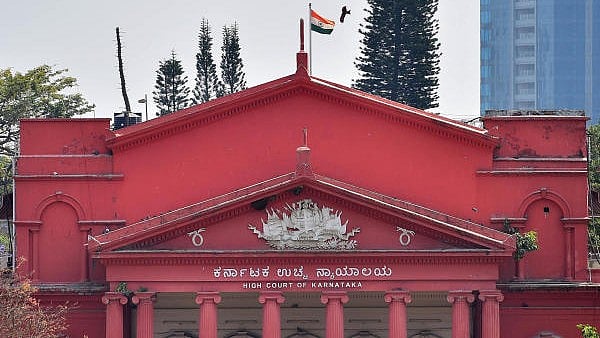
Karnataka High Court.
Credit: PTI Photo
Bengaluru: The Karnataka High Court has conditionally allowed the state government to continue the recruitment/promotion process already initiated under the amended legislation of 2022 that enhanced the reservation for Scheduled Castes and Scheduled Tribes.
A division bench of Chief Justice Vibhu Bakhru and Justice CM Poonacha passed the order while modifying an earlier interim order restraining recruitment/promotion under the enhanced quota.
“Considering that the recruitment process has already begun under the Karnataka Scheduled Castes and Scheduled Tribes (Reservation of Seats in Education Institutions and Appointments of Posts and Services under the State) Act, 2022, we consider it appropriate to modify our order dated November 19 to direct that no further notifications for recruitment or appointment on the basis of increased reservation would be issued till the disposal of the present petitions. The recruitment pursuant to the process that has already begun may be continued. However, any appointment made shall be subject to the final outcome of the petitions,” it ruled.
The court said that all appointment/promotion letters would expressly indicate that the appointments/promotions are subject to the outcome of the pleas, and the candidates would not claim any equities if the increased reservation is struck down.
Under the amended Act of 2022, reservations for persons belonging to SC and ST communities have been increased from 15% to 17% and 3% to 7%, respectively. The reservation for backward classes continues at 32%.
Mahendra Kumar Mitra, a social activist from Raichur, and others have challenged the enhancement, contending that by virtue of the legislation, the quota for reserved categories exceeds 50% and runs contrary to the law laid down by the Supreme Court. They also submitted that the National Commission for Scheduled Castes and the National Commission for Scheduled Tribes had not been consulted as required under Articles 338 (9) and 338-A (9) of the Constitution.
In its interim order on November 19, the high court restrained the state from implementing the increase in reservations in terms of the said Act till the next date of hearing and directed the state not to increase the reservation.
The state filed an interlocutory application (IA), submitting that the notifications had been issued for undertaking recruitment, and the process had begun prior to the interim order. If the process that has already begun is interdicted, the state would suffer a shortage of manpower, it added.
The government further argued that on May 1, 2023, the Supreme Court had permitted the state to go ahead with the selection process, directing that all appointment and promotion letters would specifically mention that such appointments and promotions are subject to the final outcome of the proceedings.