
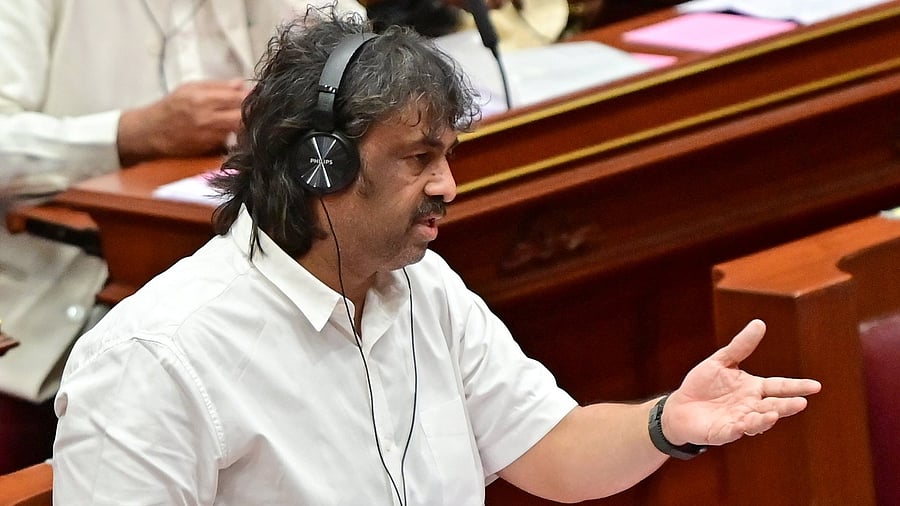
School Education and Literacy Minister Madhu Bangarappa
Credit: Special arrangement
Bengaluru: Karnataka is likely to withdraw the amendments made to rules that prioritised, and effectively restricted admissions under the Right to Education (RTE) Act in government and aided schools.
Speaking to DH, School Education and Literacy Minister Madhu Bangarappa said that several Congress leaders, including Rahul Gandhi, were particularly concerned about it.
"Now, there is a Supreme Court order which directs all states to implement 25% RTE quota in private schools effectively. I will bring it to the notice of Chief Minister Siddaramaiah," he said.
However, as withdrawing the amendments will have financial implications, the opinion and decision of the Finance Department will also be taken into account, the minister added.
"We need Rs 500 crore to pay towards reimbursements to private schools if 25% seats are filled under RTE Act," Bangarappa said.
Bangarappa said he has no objections to withdrawing the amendments to Rule 4 of the RTE Act.
Though Karnataka was the first state to implement the RTE Act, in 2019, the state brought amendments to the rule 4 of the Act by exempting private schools if government/aided schools are nearby/neighborhood (within 1 km).
The government justified it by saying that it was done to increase admissions at government schools.
With this amendment, the state government prioritised admissions at government and aided schools. This has declined demand for admissions under RTE, with 90% of the seats left vacant.
SC directive
On January 14, the Supreme Court directed states to strictly enforce the 25% reservation for Economically Weaker Section children in private unaided non minority schools under the RTE Act, 2009.
Describing it as a 'national mission', the court mandated that states frame binding rules to ensure that the quota is filled, emphasising it is a legal obligation, not a policy option.
In 2016-17, the admissions under RTE were decreased due to various technical issues, which included the submission of fake certificates by parents. Of the 86,000-plus applications, around 34,000 were rejected due to invalid caste/income certificates and over 24,000 were rejected because of invalid Aadhaar/Voter ID.
Year-wise RTE admissions
2012-13 1,22,000
2014-15 92,543
2015-16 1,00,067
2017-18 1,09,001
2018-19 1,16,273
2019-20 1,312
2020-21 3,680
2021-22 4,755
2022-23 1,512
2023-24 2,306
2024-25 3,412