
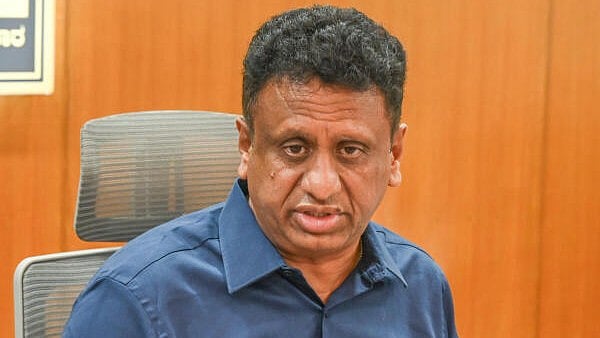
Dr M C Sudhakar
Credit: DH photo/ S K Dinesh
Bengaluru: For the next academic year, the government may impose restrictions while approving seats for engineering courses, especially computer science (CS) and related streams.
Considering the number of seats available in these streams and keeping the unemployment problems likely to erupt in the coming years, the department of higher education wants to regulate intake of students. For this, Karnataka is planning to follow the Telangana model.
Announcing this in the recently concluded session of the legislature, Higher Education Minister Dr M C Sudhakar expressed concerns over unscientific enhancement of seats, only for a few streams.
The minister assured the Council that the government would put a cap on intake for CS and related streams.
The minister, whose efforts to do it by approaching the All India Council for Technical Education (AICTE) failed, is now planning to emulate a Telangana government order, which was upheld by the High Court and Supreme Court.
“As soon as I took charge of this portfolio, I wrote to AICTE requesting to regulate seats in some engineering streams. But AICTE refused to do so, saying enhancement of seats was based on demand,” Sudhakar said.
Considering the unemployment rate, the government has already implemented Yuva Nidhi, a monthly incentive scheme for graduates.
Data from the department of technical education reveals that of the 1.53 lakh total seats available for engineering courses, 99,707 seats were in CS and related streams. That’s 64% of all engineering seats. A majority of the seats were in private universities and private unaided colleges in tier-1 cities.
Experts said enhancing seats abnormally only for CS and related streams would kill the spirit of engineering education itself.
“This year, we saw seats for CS and related streams at a few private universities and top colleges increased between 3,000 and 4,000. This is not a healthy development and definitely creates unemployment as all of them will graduate at a time,” said the principal of a private engineering college. He said this enhancement would lead to more supply than demand and naturally increase unemployment.
According to data, one of the private universities in Bengaluru added 4,500 seats in CS and related streams this year.
“Surprisingly, all these seats were filled. Imagine, all 90,000 plus graduates in CS and related streams coming out after four years and hunting for jobs,” said a former VTU vice-chancellor.
Academicians too have welcomed the government’s decision to put a cap on seats in CS and related streams.
M N Guru Venkatesh, senior vice president of placements and skill development at Dayanand Sagar Group of Institutions, said the decision would help colleges in tier-3 and 4 cities.
“Though the cap will not have any impact on top 10 colleges, it is good to provide equal opportunities for students in both urban and rural colleges,” he said.
Guru said when there is a cap, recruiters will naturally look to colleges in tier 3 and 4 cities, if they are not getting the required numbers from colleges in tier 1 and 2 cities.”
When recruiters don’t get enough number of students in top colleges, they will go to colleges down the order. Regulation is always good,” he said.
Skill gaps
Industry experts also appreciated this move by the government and expressed concerns over skill gaps.
Narayan Raghavan, managing director, Athiya Organisational Competencies, said, “The quality of engineers graduating is pathetic, skill gap is plenty. There is no correlation between industry and syllabus. More stringent measures are needed when it comes to skills among engineering students. Soft skills have to be integrated with syllabus. As every company caters to global market, they have to again upskill them after hiring. The CS engineers will get jobs only if they are super engineers because all entry level jobs are AI-driven. In next 3-4 years, employment will be a problem if we don’t streamline”.
Athiya Organisational Competencies provides skill training to engineering graduates.