
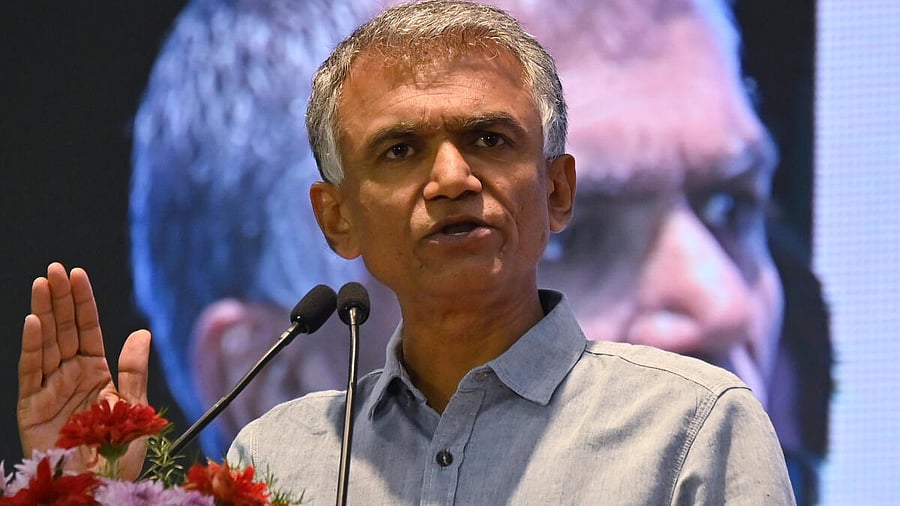
Revenue Minister Krishna Byre Gowda
Credit: DH File Photo
Bengaluru: The Karnataka government on Monday announced the rollout of digital stamp papers that citizens can purchase online without having to visit vendors, a reform Revenue Minister Krishna Byre Gowda said can curb frauds.
Stamp papers are used to carry out various transactions - sale of properties, rental agreements, affidavits and so on.
After the multicrore Telgi scam, the government switched from physical stamp papers to computer-generated e-stamp papers. But even those led to a scam with one e-stamp paper being duplicated for multiple use, resulting in loss of revenue to the government.
“We're introducing digital e-stamp papers across the state,” Gowda said. “Now, citizens can sit at home and purchase digital stamp papers on our Kaveri portal without having to depend on middlemen. This is a step towards empowering citizens,” Gowda said.
Citizens can visit kaveri.karnataka.gov.in to buy digital e-stamps and avail other services.
“The digital e-stamp papers are entirely online and secure. None can tamper with them,” Gowda said. “A digital e-stamp purchased and uploaded will be with us. So, even if the original document is lost, it can be retrieved on the portal,” he said, adding that the government is making all agreements digital. “This is totally paperless. Printouts won’t have any value.”
With digital stamp papers, Gowda said middlemen will lose their commission. “However, that doesn’t concern citizens. Also, we're not discontinuing e-stamp vendors,” he said.
In 2024-25, the government earned Rs 2,320 crore from stamp duties.
“There are 54 classifications or types of documents, each having a different stamp duty. Some are Rs 100, some Rs 500 and some based on a percentage of the total value of transaction. The existing e-stamping system is being misused. An e-stamp paper of Rs 100 is being used for a transaction in which the rate should be Rs 500. This is called mis-classification,” Gowda explained.
The government piloted digital stamp papers in October 2024, and is now scaling it up.
Each digital e-stamp has a unique serial number, a QR code and a digital watermark, which the government said makes it “impossible to misuse”.
For digital signatures, a secure link is sent to all executors on their mobile phones. Through this link, each person can digitally sign the document using Aadhaar-based e-Sign or Digital Signature Certificate (DSC). “This ensures that the document is signed only by the correct persons,” the government said.