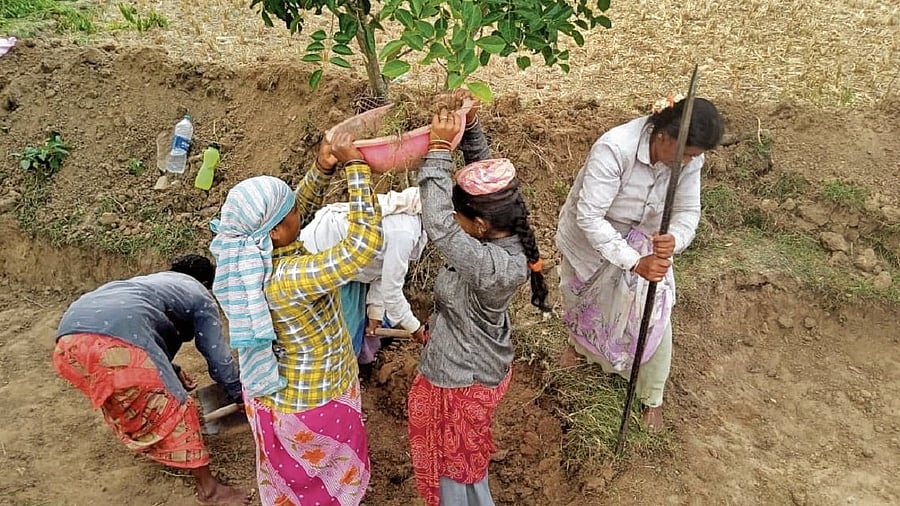
Women construct a canal in O Mittur gram panchayat in Kolar district; A rejuvenated kalyani at Pichaguntlahalli. DH Photo
Kolar district, once home to more than 4,500 tanks, has seen its lifelines dwindle to barely around 2,500 over the decades, leaving fields parched and farmers desperate. Encroachments and prolonged neglect have rendered vast stretches of farmland barren, forcing many villagers to migrate to Bengaluru in search of work.
A similar crisis prevailed in O Mittur gram panchayat in Mulabagilu taluk in 2017. Lakes and tanks ran dry and borewells drilled as deep as 1,500 feet yielded no water. Safe drinking water was hard to come by. The Koramangala–Challaghatta (KC) Valley project, which supplies treated wastewater to recharge groundwater in drought-prone areas, along with sporadic rains, offered some relief. Yet a large part of the panchayat continued to reel under drought-like conditions, as local water bodies lacked the capacity to store water.
This grim reality deeply troubled S Asha of Minijenahalli under O Mittur gram panchayat. As a member of an NGO working on rural development, she had travelled across Kolar and knew the ground situation well.
“Born and brought up in the rain-rich landscapes of Thirthahalli in Shivamogga district, I moved to the dry plains of Kolar after marriage. I soon realised that my gram panchayat suffered severe water scarcity despite having several lakes and kalyanis — most of them choked with silt. Initiating desilting through rural employment schemes came with its own challenges. I felt we had to protect every available source of water,” she said.
Driven by this conviction, Asha founded Arohana Grameenabhivruddi Samsthe, a women-led organisation focused on water, soil, and green initiatives, in December 2018.
Drawing inspiration from Gandhian ideals of Grama Swaraj and guided by the belief that “strengthening tanks strengthens villages and the nation,” Arohana set out to revive waterbodies long considered dead. With guidance from water expert Vishwanath S of Biome Environmental Trust, Asha mapped 26 lakes in the gram panchayat and prepared a comprehensive revival plan.
Funding, however, proved to be a major hurdle.
“Development requires donors,” said Asha. “We approached at least 12–15 local companies with our proposal, but none responded. Eventually, a couple of Bengaluru-based companies visited the area and decided to support us under corporate social responsibility (CSR).”
After two years of groundwork — raising funds, planning operations, mobilising villagers and securing gram panchayat permissions — Arohana began desilting the inlet and outlet channels of a lake in Pichaguntlahalli in 2021–22.
“It was not easy, but we remained focused on our goal of preserving these lakes for future generations,” Asha recalled.
Over the past four years, Arohana has desilted 14 lakes, four kalyanis, six wells and around 10 inlet and outlet channels across 13 villages in O Mittur and neighbouring Angondahalli gram panchayats.
“We first mark the lake boundaries and divide the lake area into modules based on technical details and suggestions of localities. Large lakes require excavators, while small waterbodies and channels are desilted by local workers, especially women. The nutrient-rich silt is then given free to farmers for use on their fields or for non-commercial purposes like laying approach roads,” Asha explained.
One module equals 10,000 cubic metre of lake area and desilting a module takes at least 15 days with two excavators operating for a minimum of 10 hours a day. So far, more than 48,000 tractor-loads of silt have been distributed to over 400 farmers. The group’s supervisor ensures that none of it is diverted to commercial enterprises such as brick kilns.
Women empowered
Arohana’s most striking achievement is the dignity and financial independence it brings to rural women. Led by a seven-member all-women board, the organisation employs local women for most of the desilting work, providing them with Rs 500 a day along with meals.
The rejuvenated tanks have revived local economies as well. Fishing rights are now auctioned, providing a source of steady revenue to the gram panchayat.
“Desilting has significantly increased our lake’s water-holding capacity. Every cubic metre desilted adds 1,000 litres of storage. The panchayat now earns from fishing rights and farmers around the lake benefit greatly. Such work should happen in every village,” said Venkataramana, a member of the O Mittur gram panchayat.
The results are visible. In Pichaguntlahalli, where only a handful of farmers once grew paddy, 58 farmers now cultivate two crops a year.
“When the group approached us, we visited the site and immediately recognised the need. Arohana used our CSR funds effectively, benefiting farmers and villagers. We will continue to support such initiatives,” said Tejaswini of Val Tech, Bengaluru.
Nurturing green habits
Beyond tank revival, Arohana promotes a culture of sustainability. With support from corporate donors, it has sponsored the education of 50 girls, set up computer labs, provided books and school materials, supplied play equipment to anganwadis and distributed tailoring machines. Women-led financial literacy camps and awareness drives have encouraged community participation in ward and gram sabha meetings.
Every woman in the gram panchayat is encouraged to plant two fruit saplings in front of her home, and today, 1,225 households are nurturing plants. Many lakes are being developed as bird habitats through afforestation along their banks. Rainwater harvesting systems have been installed in four high schools and eight homes as models to promote water conservation. These efforts have not gone unnoticed. Arohana has received multiple recognitions.
Despite scepticism and gendered mockery in the early days, the team has persevered with determination. Today, their work stands as a model for the entire Kolar region, proving that with vision, commitment and collective action, women can restore waterbodies and transform communities.
(Translated from Kannada by Divyashri Mudakavi)