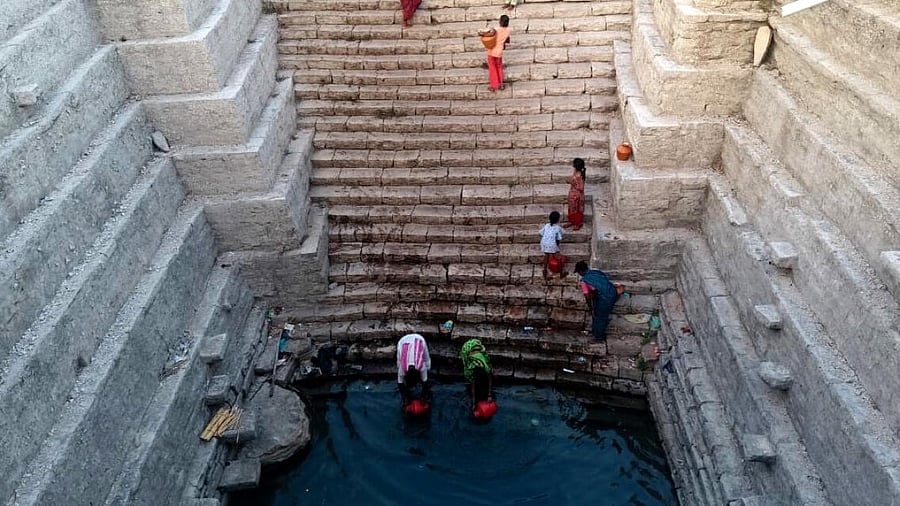
Credit: Special Arrangement
Kalaburagi: Several parts of north Karnataka region have been facing acute drinking water problems as most of the barrages and lakes have dried up. The depletion of the water table has compounded the woes in rural areas, forcing people to walk miles to fetch water.
The problem aggravated in the last one-and-half decade after Maharashtra stopped releasing water to Bhima river from Ujjani dam.
The neighbouring state has not yet released water from Koyna dam despite pleas by Karnataka to ensure drinking water to parts of Belagavi and Bagalkot districts.
The district administrations had identified more than a thousand problematic villages that would face drinking water scarcity before the start of summer in Kalyana Karnataka region.
Pure water has become a distant dream for rural people as many reverse osmosis (RO) plants installed in many villages are no longer in operation, forcing them to depend on borewell water having high fluoride content.
Villagers cite the failure of the agency concerned and gram panchayats (GPs) to maintain the RO plants.
Out of 1,190 borewells in Kalaburagi district, 454 borewells have become defunct. A total of 323 private borewells have been identified to supply water in case of emergency.
The administration had identified more than 260 problematic villages that would face problem in May.
Sewage water is entering rivers, lakes and dams. Water in the Bhima, Amarja, Kagina, and Mullamari rivers is not suitable for drinking, due to absence of water treatment plants.
“The lone RO plant in our village cannot cater to the pure water requirement of the 2,400 people here. Due to this, many people are dependent on borewell water though it is not potable. Officials have not taken measures to instal another RO plant despite several appeals,” said R H Kalamangi of Kalmangi village in Sindhanur taluk of Raichur district.
Maintaining that there was no drinking water problem in the district at present, Raichur zilla panchayat CEO Rahul Tukaram Pandve said more attention was being given to around 90 villages by identifying them as problematic ones.
“Around 40 villages in the district are dependent on 250 impounding reservoirs in the district and these are already filled by supplying water from Tungabhadra dam. This water will last for the next 70-75 days. We have hired private borewells as more than 60% of the villages are dependent on borewells for drinking water. We are supplying water to the people through 3-4 government borewells in every GP limit. Private borewells can be used if water yield from government borewells reduces in May,” he said.
He said measures were in place to provide drinking water in public places in the wake of heatwaves.
Tungabhadra reservoir assistant executive engineer Basappa Jankar said there was a storage of 7.76 tmc ft in the dam, which is also getting inflow of 2,000 cusec daily.
“Water is being supplied through canals for drinking purposes and steps have been taken to fill old lakes. Adequate water storage has been maintained to meet the requirement up to June-end,” he added.