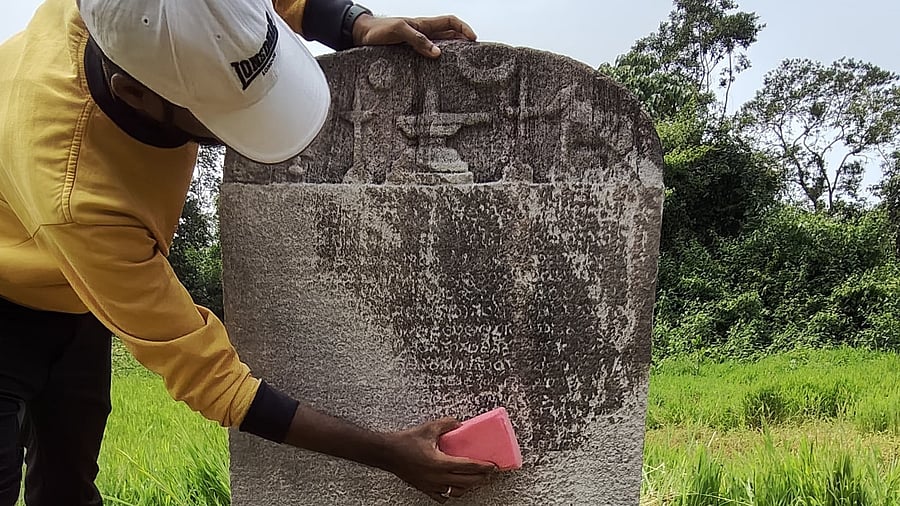
Mangaluru: Inscriptions have long served as primary sources for reconstructing history. Today, technological advancements such as high-resolution imaging, digital archiving and other unconventional methods are transforming the way these ancient records are studied and preserved, complementing traditional methods with greater accuracy and accessibility.
Among those at the forefront of this shift is Shruthesh Acharya, an epigraphy expert and museum curator at Kuvempu University. His work combines meticulous field methods with modern documentation techniques. Shruthesh has independently discovered and transcribed over 100 inscriptions and has read more than 200 inscriptions on request, especially those found in the coastal Karnataka region. They include a 15th-century inscription at Ballamanja and the Bukkaraya I inscription.
He performs careful estampage of inscriptions and creates a digital repository using high-resolution images that capture even the finest details. To strengthen authenticity, he also records videos of the sites.
Shruthesh emphasised that stone slab inscriptions, most of which are carved on granite, must be handled with extreme care. “Rough handling can damage or break them. Preserving history begins with recording it accurately,” he said.
According to Shruthesh, transcribing an inscription can take seven to 15 days, depending on its length. Negative images are preserved for archival purposes and copies of the transcriptions are submitted to the Archaeological Department. “I also make it a point to raise awareness among local communities about the importance of protecting these inscriptions,” he said. Shruthesh has created a digital archive and published research articles, including studies on the Bangarasa inscription of Sajipamuda and a herostone inscription from the Alupa period in Udyavara. He also mentors students in identifying and documenting inscriptions.
Numismatist Manderke Nityananda Pai, a renowned inscription reader who has also guided Shruthesh, noted that while the estampage method remains in use, high-resolution photography has become increasingly popular. Pai said digital techniques, often involving white chalk to highlight text, allow researchers to zoom in for better clarity and long-term reference.
Echoing this view, B Jagadish Shetty, Administrative Officer at the Rashtrakavi Govinda Pai Research Centre in Udupi, said inscriptions remain the most authentic historical sources. Shetty uses both physical and digital estampage methods.
Shejeshwar R Nayak, Director of the Archaeology Department, highlighted the broader value of inscriptions. “They offer insights into the social, religious, political and economic systems of ancient times, including taxation,” he said.
With the growing emphasis on digital archiving, Nayak said GPS-tagged records would play a crucial role in locating and preserving archaeological sites.