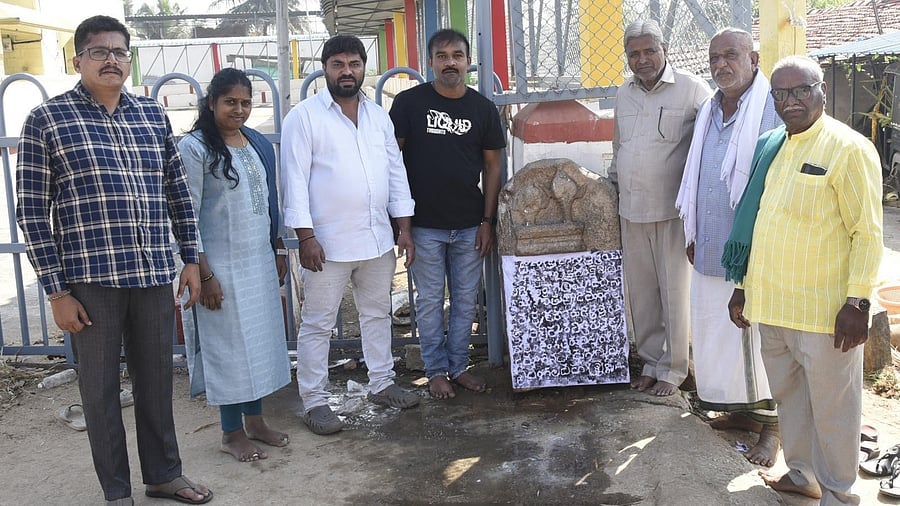
Archaeologists with the inscription at Sri Mahalakshmi Temple.
Credit: DH photo
Mysuru: A white granite slab at the entrance of a temple in Mandya district had escaped the attention of generations of devotees until scholars recently found out its historical and cultural importance.
An inscription on the slab, found at the Sri Mahalakshmi Temple at K Bettahalli in Pandavapura taluk, has opened a window to the 12th century, revealing a close relation between Hoysala Karnataka and Tamilakam.
Scholars from the Mysuru-based Centre of Excellence for Studies in Classical Kannada (CESCK) have identified that the rare and unpublished inscription dates to the tenure of Hoysala King Narasimha I (1152-1173 CE). Carved in Kannada script, the nine-line inscription utilises Kannada, Tamil and Sanskrit languages, which experts believe is an indication of a shared past cutting across language and culture.
C A Shashidhara, Junior Archaeologist at CESCK, said the inscription begins with “the auspicious invocation of ‘Svastishri’ and bears the royal emblems of conch (shanka) and discus (chakra)”.
CESCK Project Director N M Talwar said the inscription accounts for a land grant by Karikudi Tillai Koottandi, a Dandanayaka (military commander) of Tamil origin.
Koottandi donated the village of Mudana Battahalli — present-day K Bettahalli — to support rituals and festivals at the Sri Vittirunda (Krishna) Temple, located at Sri Yadava Narayana Chaturvedi Mangala (modern Keretonnuru).
“This clearly shows that Tamilians occupied senior positions in the Hoysala military and were active patrons of temples across Karnataka. It reflects a deep, everyday connection between the two regions,” Talwar said.
The discovery was made possible with local inputs, received by archaeologist Shashidhara, who realised the stone’s value. The Mahalakshmi Temple has undergone an extensive renovation, erasing most of its original features.
Except for the inscription and a broken soapstone ‘kalasha’ found near the sanctum sanctorum, very little evidence remains to prove the temple’s age.
“We also found an inscription on the pedestal of the goddess that reads ‘Sri Mahalakshmi Deviyaru’ in Hoysala script. If these remnants are lost, an 850-year-old history will vanish,” Shashidhara said.
Archaeologist N S Rangaraju said that Koottandi’s land grant was not a one-off act. “Records from nearby Tonnur (Kere) indicate that the commander had earlier purchased the land for 80 gadyanas to donate it to the same deity. These findings show a shared past, where language, power, and faith cross regional boundaries with ease,” he said.