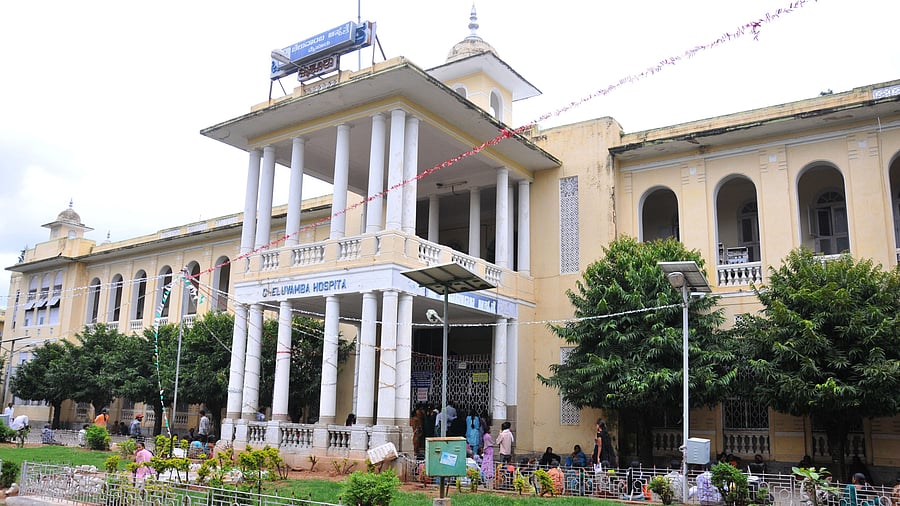
Cheluvamba Hospital in Mysuru.
Credit: DH File Photo
Mysuru: A Mysuru-based foundation of the erstwhile royal family is launching a health movement called 'Swastha Mysuru', in association with a Delhi-based NGO, on December 5, Sunday, at Wadiyar Centre for Architecture, in Mysuru. Karnataka State Health Minister Dinesh Gundu Rao will be the chief guest.
H H Sri Srikantadatta Narasimharaja (SDNR) Wadiyar Foundation, in association with Arogya World India Trust, is launching 'Swastha Mysuru', a campaign to mobilise Mysuru's companies, NGOs, start-ups, schools, colleges, hospitals, government agencies and multiple stakeholders to join hands, and to contribute voluntarily to tackle non-communicable diseases and mental health.
Cooperation sought
Honorary secretary of SDNR Wadiyar Foundation Reginald Wesley said, president of the foundation Pramoda Devi Wadiyar held an informal interaction with concerned and like-minded citizens and heads and office-bearers of organisations on Tuesday, to get suggestions and also their commitment for the success of the health movement.
It can be noted that the Wadiyar kings were the pioneers in promotion of modern healthcare in the entire South Asian region. The contributions of the Wadiyars, especially during the reign of Chamarajendra Wadiyar X and Nalvadi Krishnaraja Wadiyar, created a framework for modern healthcare. Their administration prioritised scientific medical education, specialised care for women and children, and essential public health infrastructure, establishing a legacy that continues to benefit Karnataka State up to this time.
Early steps
The Wadiyars made significant and foundational contributions that paved the way for modern healthcare services and infrastructure in the region, particularly during the late 19th and early 20th centuries. Their vision transformed healthcare from traditional practices to a scientifically-driven, accessible system.
In fact, it is believed that the world's first vaccine campaign portrait is of the Mysuru queens in 1805. Three royal women of the Wadiyar dynasty became the face of a smallpox immunisation campaign. The smallpox vaccine arrived in India in 1802. But, its acceptance was slow, due to public suspicion, cultural resistance, and distrust of the British East India Company. To overcome this, the East India Company commissioned a portrait by an Irish painter Thomas Hickey around 1805. The women in the portrait are believed to be Queen Devajammani; a co-queen of Mummadi Krishnaraja Wadiyar III, also named Devajammani; and dowager queen Lakshmi Ammani.
Maternity care
Cheluvamba Hospital (maternity hospital), established in 1880, was one of the earliest and most comprehensive maternity hospitals in India. Krishna Rajendra (KR) Hospital, named after Nalvadi Krishnaraja Wadiyar was established as a major general hospital in Mysuru city. Mysuru Medical College and Research Institute, established in 1924, during the reign of Nalvadi Krishnaraja Wadiyar, was one of the first medical schools in South India, outside the erstwhile Madras Presidency.
The Wadiyars were also pioneers in sanitation and water supply. They initiated modern urban planning and included improved sanitation systems and provided protected drinking water to cities like Mysuru and Bengaluru, which helped to control water-borne diseases like cholera and typhoid.
Epidemic
During plague and smallpox outbreaks in the late 19th and early 20th centuries, the administration, particularly under Nalvadi Krishnaraja Wadiyar, implemented modern epidemiological measures, including isolation wards, compulsory vaccination drives, and public awareness campaigns.