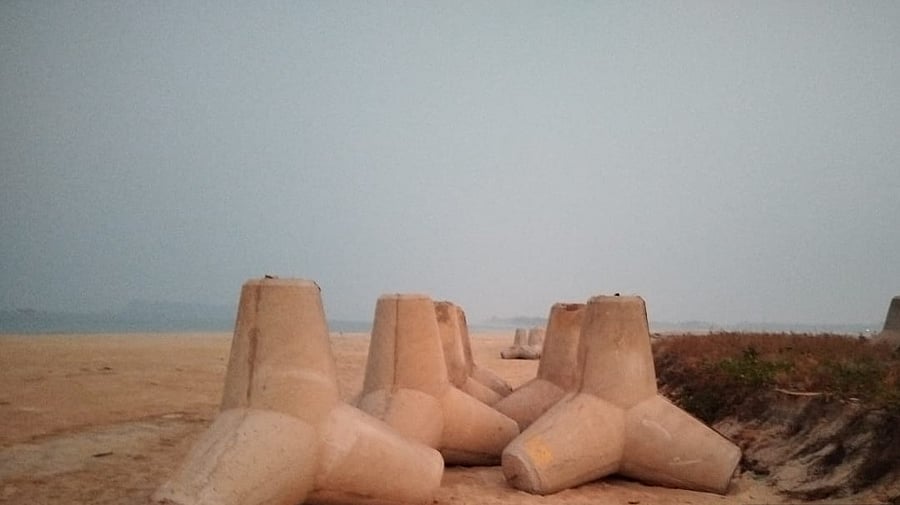
Honnavar’s Kasarkod Tonka beach
Credit: Special Arrangement
Hubballi: Contradictory to the assurance that the nesting site of the Olive Ridley sea turtle will not be impacted from the construction of private port at Honnavar’s Kasarkod Tonka beach; the round the clock work at the site has meant that not a single female turtle has arrived at the beach to lay eggs this season.
Usually, the turtles would have reached the shores of Honnavar division by the first week of December to lay eggs in the sandy beaches. Last year too, by mid January nearly eight turtles had laid eggs on this beach and over 90 hatchlings of one of the nests were released into the sea on January 30 after completing the 48-day gestation period.
Though the breeding season of the turtle runs from December to April, experts believe that it is highly unlikely that the critically endangered turtles protected under the Wildlife Protection Act would come to Kasarkod Tonka to lay eggs henceforth.
Marine Biologist Prakash Mesta says the Olive Ridley sea turtles are very sensitive and lay eggs in the pitch of darkness and in secluded places. “There is high movement of heavy vehicles day and night. The trucks are dumping boulders and tetra-port on a section of beach that was ideal for turtle nesting. With so much disturbance the turtles would never come to lay eggs. We have lost an ideal nesting site forever,” he says.
Mesta says that these turtles have natal homing behavior, meaning a turtle born in those shores will come back to lay its eggs on the same beach. “The private port officials and port officials had assured of taking mitigation and conservation measures to protect the sites. However, none of those steps are being followed,” he said.
The Honnavar division is a crucial breeding ground that annually used to record 35–40 females nesting on its beaches. In 2023, a record 83 females had made this 3 km stretch between Apsarakonda and Pavinkorava, including Kasarkod Tonka, their breeding grounds. Forest Department records show that over the last two decades, the breeding ground of sea turtles in Karnataka has shrunk from 15 beaches to five or six due to construction and infrastructure projects.
Multiple videos that local fisherfolks have shared with DH claim that trucks with high beam lights plying on the mud-road next to the beach after 11 pm, though the forest department has allowed them to transport the materials between 6 am and 10 pm.
Honnavar Deputy Conservator of Forests Yogeesha C K says the division used to record sporadic incidents of turtle nesting and these beaches are not regular nesting sites. “We don’t know the exact reasons as to why the turtles have not nested in the division so far. We still have time till March for them to arrive at the shores,” he said.
He, however, does not consider construction of the private port as the main reason for turtles skipping the shores this season. “We have asked the private port officials to halt the work between 10 pm and 6 am. They have agreed to it,” he said and added that videos provided by the fishermen are within the permissible hours of work.
Yogeesha also stated that though the department's top priority is conservation of turtles, they are helpless as majority of work is being taken up in revenue land.
He also rejected the claim of fishermen that a large number of turtles used to lay their eggs on these beaches. “Port authority officials have claimed that they have CCTV videos to prove that some locals to derail the project used to plant eggs in these beaches after getting them from elsewhere,” he said.
Honnavar Port Private Limited's Executive Director Raghavendra Reddy claims Kasarkod Tonka isn't a turtle nesting site. He alleges locals planted turtle eggs to derail the project. "The National Green Tribunal reviewed video evidence and ruled in our favor. Thanks to Supreme Court orders, we're implementing the project after 12 years of delay, with no rule violations," he says. Reddy adds that fishermen are illegally building houses, violating CZR norms, but face no action.