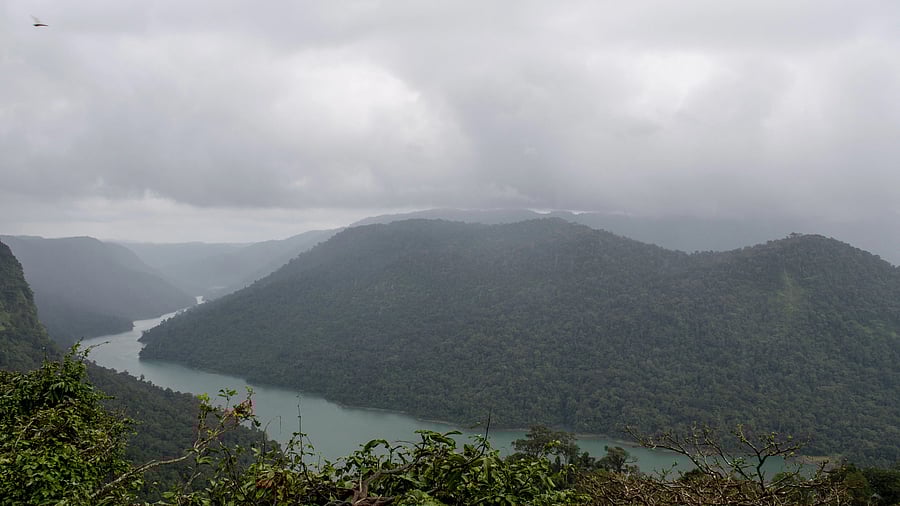
A view of Sharavathi valley. The proposed Sharavathi Pumped Storage project impacts one of the last safe havens of Lion Tailed Macaque, a critically endangered species endemic to Western Ghats.
Credit: DH File Photo
Bengaluru: In a big boost to the controversial power project proposed in the Sharavathi Valley Lion Tailed Macaque (LTM) Sanctuary, Karnataka has approved the framework for a wildlife mitigation plan even as the National Board of Wildlife (NBWL) has embarked on a site visit to understand the impact of works in the fragile area.
DH has a copy of the framework and the recommendation letter written to the government by Principal Chief Conservator of Forests (Wildlife) and Chief Wildlife Warden P C Ray.
Proposed by the Karnataka Power Corporation Limited (KPCL), the 2,000 MW pumped storage project involves generating power by building an underground powerhouse between Talakalale and Gerusoppa dams. Of the 352.77 acres sought for the project, 131.81 acres is reserved forest.
Being situated in a sanctuary, a protected area, the proposal requires approval from state and central wildlife authorities.
This is a prerequisite for another approval: the diversion of forest land. Work on the ground can begin after receiving both the approvals.
Apart from quoting materials available in secondary sources, the framework doesn’t provide any details regarding the actual and site-specific mitigation measures required on the ground. In his letter to the government, Ray stated that the adequacy of the measures proposed by the framework cannot be ascertained as no scientific assessment has been conducted regarding the project impact area and potential impact of the project on the wildlife.
However, the officer cleared the document as a framework. “It is recommended that a detailed wildlife mitigation plan be prepared by a scientific institution, such as Wildlife Institute of India, after a thorough study of all aspects of the project area, and submitted to the chief wildlife warden for consideration and approval,” his recommendation said.
Vague approvals
The approval is similar to the opaque manner in which the project has received a push at each level. The state and the Union governments have come under criticism for pushing the project without disclosing any of the crucial details.
It began in January, when the State Board of Wildlife (SBWL) approved the project without including the mitigation conditions proposed by the forest department, though the same was announced by Forest, Ecology and Environment Minister Eshwar Khandre.
In July, the National Board of Wildlife also gave “in-principle” recommendation to the project. The committee included the conditions that were omitted by the SBWL. The approval was given even though the condition included directions that would change salient features of the project.
Following written submissions by two members, the standing committee of the NBWL directed a three-member committee to visit the site and submit a report so that the proposal can be considered once again. Sagar-based conservationist Akhilesh Chipli said one cannot expect anything better from the Karnataka Forest Department. “The framework is just another formality with its entire content being simply copy-paste from secondary sources. A graduate student can prepare such a document in one day,” he said, adding that the Chief Wildlife Warden has “completely ignored” the spirit of the Wildlife Protection Act.
Fragile area
The sanctuary comprising areas susceptible for landslides was created to save the arboreal LTM, which has been declared an endangered species. It also supports other threatened species in the area, including tiger, leopard, slender loris, pangolin, dhole.
The framework document relied on secondary sources to speak of the direct and indirect impact on the area. For the LTMs, the document spoke of building 15-metre long canopy bridges to cross the new roads.
However, there was no clarity on how they will mitigate the habitat disturbance, soil erosion, wildlife disturbance, increased landslide and flood risk as well as indirect impacts like water degradation, cumulative ecological stress and reduced disaster resilience.
Chipli noted that the the Standing Committee of the NBWL was empowered to approve only those projects that serve the best interests of wildlife.
“Since this is an energy infrastructure project involving extensive tunneling, blasting with explosives, building underground powerhouse etc and has no connection to wildlife conservation, there is no legal basis under the Wildlife (Protection) Act, 1972, to grant it even an ‘in-principle’ approval,” he added.