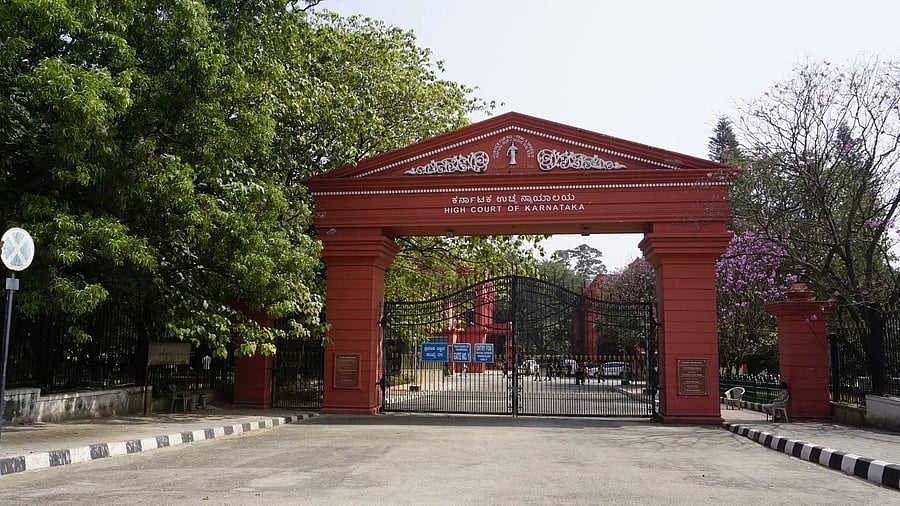
Karnataka High Court.
Credit: iStock Photo
Bengaluru: The Karnataka High Court on Friday quashed the order permitting the invocation of the provisions of the Karnataka Control of Organised Crime Act, 2000 (KCOCA) against BA Basavaraja, BJP MLA from KR Puram constituency, in the Shivaprakash murder case. Basavaraja is accused number 5 in the case. Meanwhile, the court has rejected the application filed by him seeking anticipatory bail in the case.
Byrathi Basavaraja has filed two petitions, one challenging the order invoking the provisions of KCOCA and another challenging the FIR registered against him in the murder case. Basavaraja withdrew the petition challenging the FIR.
In the petition challenging the provisions of KCOCA, Justice S Sunil Dutt Yadav said that the charge sheets filed are required to establish a continued link regarding the nature of offences to interpret the term ‘Continuing Unlawful Activity’ under the provisions of KCOCA. The court noted that though in the case at hand, the order of prior approval seeks to make out a case of unlawful activity committed in relation to a real estate transaction, prima facie, the gist of the investigation mentioned in the order does not reflect the offence in relation to real estate. While the use of criminal force and causing harm may be common in both, the ‘Continuing Unlawful Activity’ with the object of real estate pecuniary advantage as indicated in the order of approval is absent, the court said.
"Accordingly, it can be stated that the legal requirement of organised crime, which involves ‘Continuing Unlawful Activity’ as contemplated under Sections 2(1)(d) and 2(1)(e) of KCOCA, is not satisfied. None of the other accused persons have against them two charge sheets involving offences of punishment of more than 3 years. Accordingly, while noticing that it is only against accused No.18 - Patrick that there were two charge sheets that would fall within the requirement of punishment of imprisonment with 3 years or more, which, however, would not fall within the definition of ‘Organised Crime’ as contemplated under Section 2(1)(e) of KCOCA. In light of the discussion made supra, the order of approval is defective. The invoking of the provisions under KCOCA would not stand legal scrutiny. While it is indeed correct that invocation of KCOCA is against the ‘crime’ and not the ‘accused’, however, the legal requirement would mandate that there has to be ‘Continuing Unlawful Activity’ for which the ingredients of Section 2(1)(d) of KCOCA require to be satisfied, which is absent," Justice Sunil Dutt Yadav said.
In the application seeking anticipatory bail, the court observed that the custodial interrogation is a legal option available to the investigating agency and there is no reason to deny such exercise of power.
"Further, the material would indicate that the deceased, in writing, stated that the henchmen of the petitioner threatened him. In light of the same, the Court is not inclined to exercise the extraordinary power under Article 226 of the Constitution of India, particularly in light of the factual matrix referred to above. Further, the investigation is still to be completed, and an order granting anticipatory bail may interfere with the investigation of a heinous offence," the court said.
The court reserved liberty to seek appropriate relief before the appropriate court, while clarifying that the observations made are limited to the disposal of the present interlocutory application and must not be construed to be a conclusive finding on the merits of the matter.