
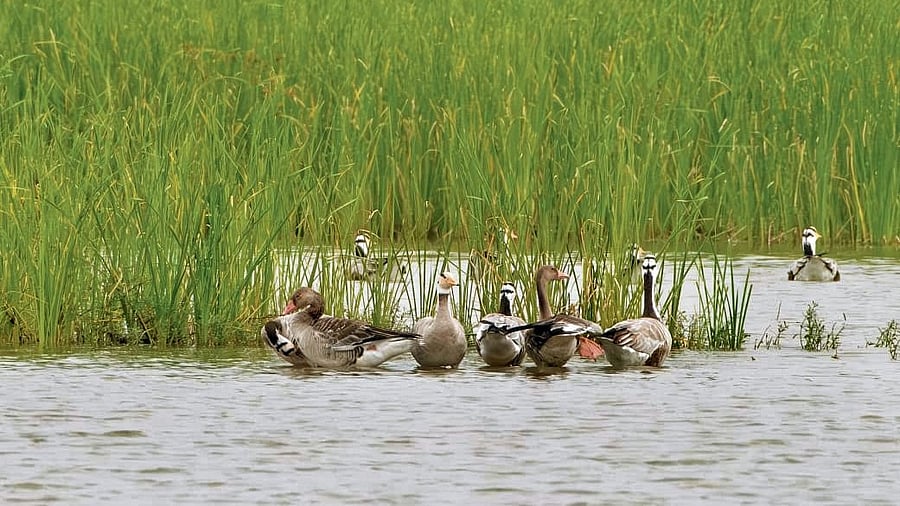
Overgrowth of typha weed and excess rainfall are among reasons why Magadi lake in Gadag district is said to have attracted fewer bar-headed geese this season.
Credit: Manjunath Nayak
Hubballi: The migratory bar-headed geese are abandoning their winter home Magadi lake in Gadag en masse, even before the season has concluded.
Only 700 to 1,200 birds were to be seen here on Sunday. In a normal year, an estimated 7,000 birds arrive at this lake in November and stay till the last week of March.
Multiple factors, including overgrowth of typha, a water weed, excess rainfall during monsoon and threats from feral dogs are said to have caused disruption to these birds, which migrate from Mongolia, Tibet and parts of China, crossing the heights of Mt Everest to escape extreme cold.
Ramsar site
Keeping in mind the importance of this roosting site, the lake was designated a Ramsar site in 2024. The lake’s shallow waters and the abundance of green gram crops in the surrounding fields once attracted thousands of them, making it one of south India’s largest congregations of bar-headed geese.
Researcher Manjunath Nayak, who has been recording the arrival of these birds for the past 12 years, says Magadi lake is losing its reputation as a migratory destination.
“We have recorded more than 12,000 geese in a single season. However, over the last 6 to 7 years, the numbers have not crossed 6,000. The first fortnight of November 2025 saw the arrival of over 5,000 geese, but on Sunday (January 4), there were hardly a few hundred roosting at the lake. This is worrying,” he
said.
New breeding place
A significant number of birds have shifted to Shettikeri lake, 6 km from the Magadi bird sanctuary.
Manjunath said Magadi lake is witnessing the growth of several weeds, including rapidly spreading typha and water hyacinth. These weeds are reducing the space for birds.
Unlike previous years, the water is no longer shallow — a prerequisite for the geese to rest. “Last monsoon, the region received above-normal rainfall, resulting in the lake remaining full to the brim,” he said.
Polluted water
Locals said excessive use of water for domestic purposes like washing clothes and cattle has polluted the lake, resulting the birds deserting it. Manjunath said, on average, 5 to 8 geese die every year after being attacked by feral dogs near the lake.
Ramappa Poojar, the Shirahatti range forest officer, confirmed the increase in weed growth, following desilting work carried out by villagers.
“We had requested the gram panchayat to de-weed the water body. As the forest department did not have additional funds, we could not take up de-weeding,” he
said.
‘Dogs no threat’
However, Poojar denied that feral dogs posed a serious threat, as the department records 3 to 5 bird deaths annually due to exhaustion rather than predation.
Santosh Kumar, deputy conservator of forests, Gadag, said the movement of geese from Magadi lake to Shettikeri lake was not a cause for concern.
“Such a thing has been recorded earlier as well. The birds will return to Magadi lake and there is no need to worry. We are monitoring this Ramsar site,” he said.