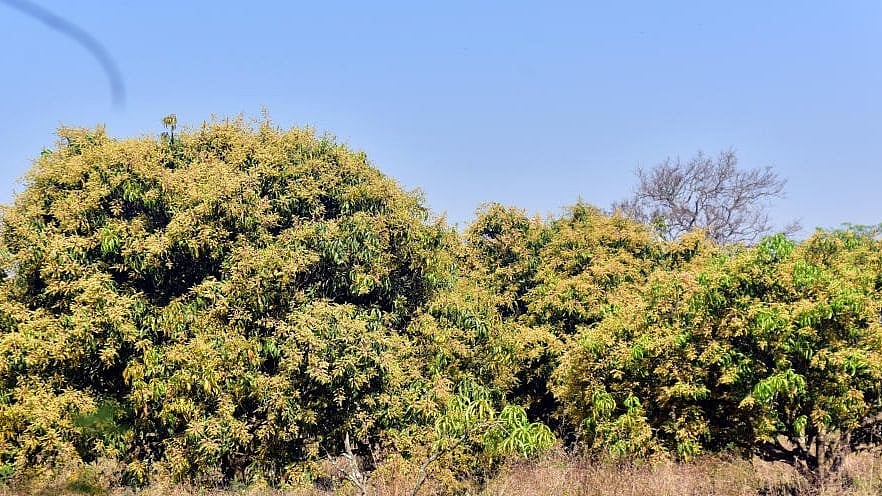
Special arrangement
Dharwad: Mango production in Karnataka is expected to rise by nearly 20% this season, buoyed by favourable weather conditions during the crucial flowering stage. After four consecutive years of erratic climate patterns, mango growers across the state are hopeful of a good harvest. Last year, mangoes were cultivated in over two lakh hectares of land and produced 10 lakh tonnes of fruit.
Premium varieties including Alphonso, Badami, Mallika, Raspuri, Neelam and Totapuri are grown in major mango growing districts Dharwad, Belagavi, Kolar, Ramanagara and Chikkaballapur.
Erratic weather patterns had severely affected flowering and fruit size in recent seasons, pushing growers into uncertainty. However, this year has brought favourable cold weather during the critical flowering stage, resulting in mango trees laden with blossoms and raising optimism among farmers.
Officials said fog during flowering stage is usually a threat to the crop. However, with the cold weather subsiding after Sankranti, the fog has also disappeared. As a result, mango production is expected to increase by nearly 20% this year, said Horticulture Department deputy director Kashinath Badrannavar.
Typically, mango flowering occurs during the winter months of December and January. In recent years, adverse climatic conditions led to sparse flowering, premature flower drop, or even complete failure of flowering in some orchards.
Mangoes are grown across nearly 18,000 hectares in Dharwad and about 15,000 hectares in Belagavi, nearly 99% of the area is under the Alphonso (Aapus) variety.
The Horticulture Department expects a mango yield of around 65,000 tonnes in Dharwad district and 50,000 tonnes in Belagavi this year.
In Kolar, mango is being cultivated in 39,331 hectares, while in Srinivaspur taluk it is cultivated in 52,000 acres. Ramanagara, is another hotspot wherein mango is cultivated in 27,000 hectares.
Kolar, Chikkaballapur and Ramanagara are known for growing Neelam, Totapuri, Badami, Raspuri, Amarpali and Mallika.
Disheartened by crop failures, many growers had begun shifting to alternative crops. Against this backdrop, the favourable weather this year, combined with the absence of major disease threats, has led to renewed confidence, said mango grower Devendrappa Jainar of Kelageri.
Badrannavar cautioned farmers against complacency, stating that good flowering alone does not guarantee a good harvest.
“Protecting the blossoms can ensure maximum fruit set,” he said, adding that growers have been advised not to spray chemicals or irrigate orchards during pollination.