
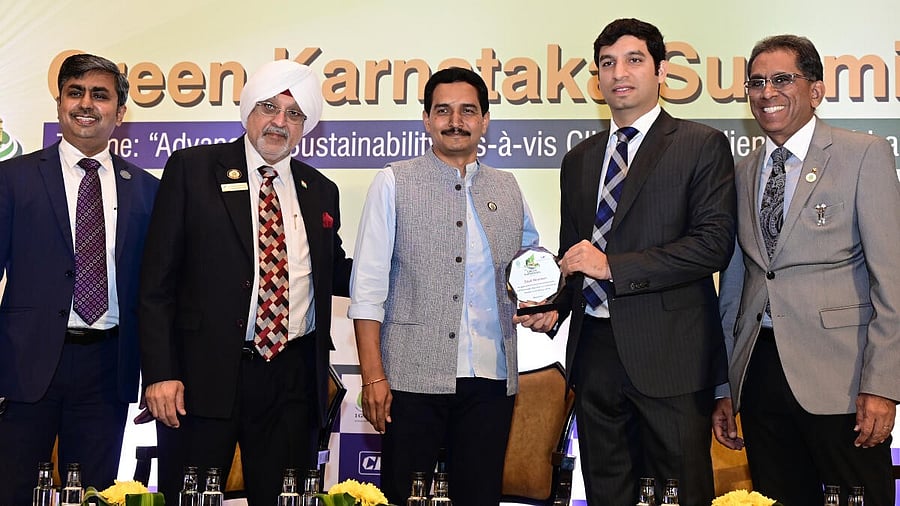
Zayd Noaman (Second from right), President of CREDAI Bengaluru hand over memento to Anup Naik, Chairman of IGBC Bengaluru during the Green Karnataka Summit organised by CII in Bengaluru on Friday. (From left) M Anand, Deputy Executive Director of Indian Green Building Council, Gurmit Singh Arora, Chairman, IGBC Marketing Outreach & Strategic Alliances and V Gopal, Co-Chairman, IGBC Bengaluru are also seen.
Credit: DH Photo B K Janardhan
Bengaluru: Karnataka’s growing footprint in green construction and the challenges of climate-resilient urbanisation were in focus at the IGBC Green Karnataka Summit 2026, organised on Friday.
Organised by the CII Indian Green Building Council (IGBC), the summit brought together government officials, urban planners, architects, developers and sustainability experts to discuss ways to align the State’s urban growth with climate and resource constraints.
Speakers at the summit noted that the emphasis is now shifting from intent to implementation, particularly in cities facing increasing risks from heat stress, water scarcity and flooding.
In his address, Maheshwar Rao, chief commissioner of the Greater Bengaluru Authority and administrator of all Bengaluru city corporations, said Karnataka’s experience showed that sustainability could be scaled across sectors.
“Karnataka’s green building journey reflects a decisive shift from ambition to execution,” he said, adding that Net Zero buildings, water security and climate-resilient design were “increasingly becoming the new normal rather than exceptions.”
He also pointed to the need for incentives, such as faster approvals and fiscal benefits, to accelerate adoption.
The summit examined urban development models that balance economic growth with long-term liveability.
Panel discussions focused on sustainable urban planning, future-ready infrastructure and Net Zero strategies across the building lifecycle.
The participants stressed the importance of integrated planning that links land use, mobility, infrastructure and ecology, alongside better coordination between agencies.
As a part of the a panel discussion on ‘Sustainable Urban Planning and Future Cities in Karnataka’, urban planner Naresh V Narasimhan urged the state government to look beyond building flyovers, and Chandrashekar Hariharan, National Executive Board Member & Senior Fellow, IGBC and Trustee, AltTech Foundation, stressed on the need for development projects to look beyond Bengaluru and enter tier two and three cities in the state.
Anup Naik, chairperson of the IGBC Bengaluru Chapter, said the state’s performance was the result of sustained collaboration.
“With over 1,500 registered green building projects covering more than 1.13 billion square feet, the state today ranks among the top three performers nationally,” he said, noting that green practices now extend across residential, commercial, industrial and infrastructure projects.
The summit concluded with the IGBC Green Crusader Awards 2026, recognising 184 upcoming green building projects spanning 83 million square feet across Karnataka, signalling continued momentum in the state’s green building efforts.