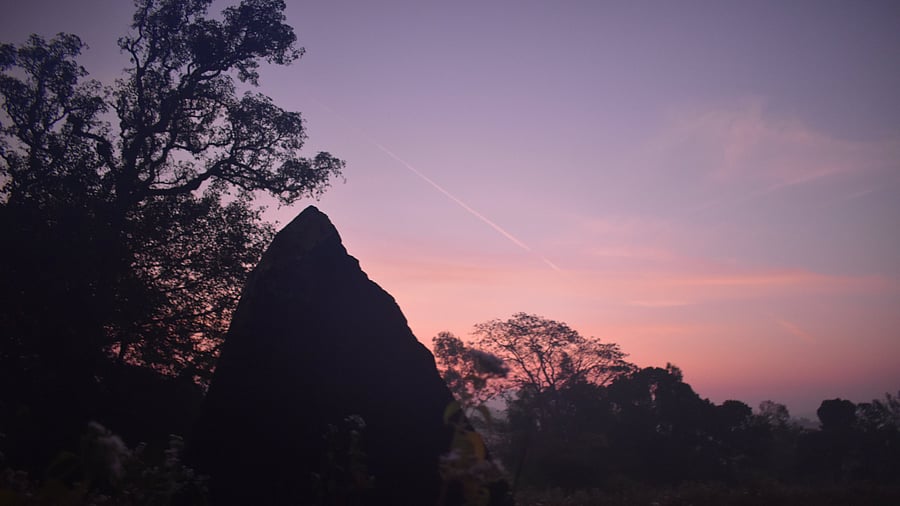
One of the menhirs at Nilaskal outlined against the sky at dawn.
Credit: Srikumar M Menon
It was just after 5 am on Winter Solstice Day, when we reached the megalithic site at Nilaskal, near Nagara, in Hosanagara taluk of Shivamogga district. The night sky was brilliant with stars, and the hulking masses of the megalithic menhirs loomed inky black against the starlit firmament.
We trudged up the slight westward incline, towards the highest part of the slope, where the menhirs ended, and waited near one of them — a prominent erect slab tapering to a sharp point, for dawn to break.
The cold was finger-numbing; we could barely push the buttons on our cameras. The Big Dipper hung high in the north, pointing to the Pole Star, and demonstrating how the creators of this monument had manoeuvred the enormous stone slabs to align closely north-south.
Presently, the eastern horizon flushed a washed-out pink, and the stars disappeared gradually as the sky brightened.
The tops of the menhirs were now discernible against the sky. One could see how the prehistoric builders at Nilaskal had sited the taller menhirs down the slope and the shorter ones uphill, so that their tops were almost at the same level when viewed from west of the grouping of menhirs. As we huddled deep in our jackets in the lee of the sharp menhir, and waited for the sunrise, I was overwhelmed by the thought that we were probably not the first people to have done this — millennia ago, some of our faceless ancestors from the Iron Age must have huddled similarly in the cold dark, waiting for the sun to rise over the menhirs.
Megalithic site
For Nilaskal is home to a megalithic stone alignment, believed to have been erected during the south Indian Iron Age, roughly 3500 to 2500 years ago. It consists of quarried slabs of granite and dolerite erected over a large area, roughly 100 m east-west and 300 m north-south. Each of the erect slabs is called a menhir, and the entire grouping is known as a stone alignment.
Initially, only the prominent menhirs, around twenty in number, were noticed by archaeologists, and they were thought to be erected haphazardly, without any discernible pattern. However, during investigations for my doctoral studies, I found remnants of over 110 menhirs, many of them reduced to broken stumps by the vagaries of time, and vandalism. Each individual slab is fairly accurately oriented north-south — not an ordinary feat, given that the largest menhirs weigh around 16 and 12 tonnes. The menhirs are arranged in a grid, though several broken and missing menhirs cloud this perception.
The findings indicate that pairs of menhirs formed sightlines framing the setting sun during the longest and shortest days of the year — the summer and winter solstices, respectively. This phenomenon must have been important enough for our ancestors to devote much time and effort to erect these massive stones in precise alignment, centuries ago.
Nilaskal is one of five similar sites with menhirs in the region, the others being at Byse, Heragal, Mumbaru and Aaraga Gate. It appears likely that the stone alignment at Nilaskal is the grand culmination of this series of sites, this monument being more extensive than the rest, and incorporating larger quarried slabs as menhirs.
The choice of an east-facing gentle slope at Nilaskal also seems to be deliberate, the raised western horizon thus created avoids the atmospheric haze invariably present closer to the true horizon.
The result is a dramatic spectacle at sunset, with tall menhirs silhouetted against the painted sky, and an undiminished sun setting between them. Though the menhirs also form sightlines to the rising sun during solstices, as we confirmed in the recent visit, the layout of the site suggests that sunsets were the prime spectacle here. It is conceivable that the experience accrued at the earlier sites had been put to good use while creating the imposing stone alignment at Nilaskal. This hypothesis can, of course, be verified by archaeological excavations at these sites.
Lost to time
Very few megalithic sites which incorporate deliberate astronomical alignments have been identified in India. The largest stone alignment in the country – at Hanamsagar, in northern Karnataka, was lost to agricultural expansion over a decade ago. The monument, consisting of over 2,500 menhirs, was believed to have astronomical alignments, though detailed surveys had not been conducted. The intent behind this exceptional monument will now remain an unsolved mystery forever.
Though the veracity of the solstitial alignments at Nilaskal is now beyond doubt, the site harbours many more mysteries, solving which needs persistent observations and analysis.
Could this monument be a calendrical device, with various pairs of menhirs marking the shifting positions of sunset throughout the year? Currently, this is difficult to conclude because several of the menhirs are broken, their pieces scattered around. Careful excavations could determine the original position of each menhir, enabling the calendrical device hypothesis to be tested.
It is important that Nilaskal does not go the way of Hanamsagar, or several other stone alignments in the country.
The Karimane Government school, built in 1949, occupies the northern part of the site. Presumably, some of the menhirs of the alignment were displaced, or destroyed in its construction. However, the school possibly offers the best bet to preserve this unique, though unprotected site. For what better caretaker could one desire, than a temple of knowledge, to protect and showcase this ancient heritage bequeathed us by our distant ancestors?
(The author is with the National Institute of Advanced Studies, Bengaluru)