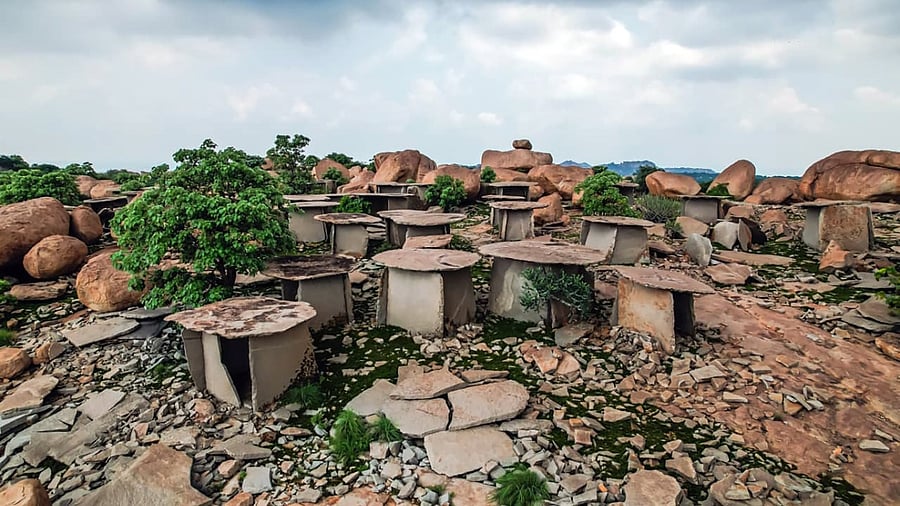
Karnataka has numerous archaeological sites showing prehistoric human habitation. In pic, dolmens at Hire Benakal in Koppal district, which is currently on the UNESCO’s World Heritage Site temporary list.
Credit: Photo by Arjun G R
Tekkalakote/ Maski/ Hunasagi (Ballari/Raichur/Yadgir): Basavaprabhu, a Class 6 student at the government primary school in Yadgir’s Budihal, gets excited whenever visitors arrive in his otherwise nondescript village. He invariably guides them to his school’s backyard, pointing out Budiguddas, the ash mounds across a five-to-six-acre area believed to be a human settlement from nearly 4,000 years ago.
An excavation carried out around four decades ago by eminent archaeologist K Paddayya identified Budihal as one of India’s earliest known Neolithic village settlements, dating to 2000–1400 BCE. Excavations of three ash mounds here uncovered stone and iron agricultural tools, pottery, animal remains and child urn burials, all characteristic of Neolithic life.
Ash mounds offer archeologists with crucial insights into early agro-pastoral life, food habits, fertility rituals and the social structure that laid the foundation for urbanisation in the present-day Karnataka region.
Many of these ash mound remains, however, have vanished, carted away by locals for use as roofing binders, compound walls or even manure.
Barely 35 km from Budihal lies Isampur, an Early Palaeolithic site that has documented the presence of Homo erectus, ancestors who lived nearly 1.2 million years ago. One of India’s major Palaeolithic sites, Isampur is known for its ancient stone quarry and tool-manufacturing site, making it an iconic location in Karnataka’s prehistory.
Electron Spin Resonance (ESR) dating of animal fossils from the site indicates human habitation nearly 1.2 million years ago. K Paddayya’s excavations on private land yielded over 15,000 limestone tools used by early humans for hunting and food gathering.
“The region holds immense potential to explain several missing links in human evolution. Unfortunately, poor conservation and protection have allowed these landscapes to be converted into paddy fields,” he laments.
Today, nearly 90% of the artefacts excavated by Paddayya over four decades in the Hunasigi Valley are housed at Deccan College, Pune. Neither the state government nor the Archaeological Survey of India (ASI) has created facilities to preserve them locally. A small portion is displayed at the Hunasigi Panchayat office, while a few cartons of artefacts sit in Basavaprabhu’s school.
Prehistoric sites bear evidence of human activity from before the invention of writing. Archaeologists reconstruct prehistoric life through material remains such as tools, dwellings, burials, rock art and food remains. They are crucial to understanding early human life, culture, technology and interactions with nature.
The prehistoric time is broadly divided into the Palaeolithic (Old Stone Age), Mesolithic (Middle Stone Age), Neolithic (New Stone Age) and Chalcolithic (Copper Age).
Karnataka’s prehistoric heritage spans over a million years, from Palaeolithic settlements in the Hunasigi Valley to Neolithic and Iron Age remains at Brahmagiri in Chitradurga. It also includes Iron Age megalithic monuments at Hire Benakal near Koppal, as well as petroglyph sites at Avalakki Pare, Buddhanajeddu, Gavali and Baradakallu Bole in Udupi district.
The multiple dobas, a Persian term for tracts of land between two rivers, stretching from Bidar to Ballari, along with the plains of central Karnataka and the coastal region, are believed to have been inhabited throughout these periods.
Experts estimate that nearly 90% of Karnataka’s prehistoric sites have been encroached upon — converted into farmland, layouts, industries, roads and canals.
Many sites are on the brink due to lack of legal protection, delayed notification as protected areas, shortage of trained staff, slow bureaucratic processes, poor adoption of modern technology, and pressures from urbanisation and agricultural or residential encroachment.
The Department of Archaeology, Museums and Heritage (DAMH), responsible for the protecting and maintaining the state’s ancient monuments, museums and heritage buildings, does not even have data on the total number of prehistoric sites in Karnataka.
Experts say that successive governments have relegated prehistoric sites to the lowest conservation priority, largely because they generate little tourism revenue.
Namita Sugandhi, an Associate Professor from Hartwick College, New York, has been studying the Neolithic site of Tekkalakote in Ballari’s Siruguppa taluk for over two decades. “The site has witnessed social, economic and ritual transformations across periods and can help us understand these shifts,” she says. She adds that the loss of evidence due to destruction or neglect creates critical gaps in the global understanding of human evolution and early prehistory.
“To present an accurate account of human evolution and trace the dispersal of hominins out of Africa to East Asia, Australia and beyond, conserving India's prehistoric sites is essential. Unfortunately, very little effort is being made to protect these sites or encourage additional scientific investigation," she explains.
Her research site lies on private farmland under dry cultivation. The fields reveal hundreds of pottery fragments and other artefacts dating back nearly 5,000 years. The nearby hills host rock carvings and paintings of bulls, humans and festive scenes — all unprotected.
Tekkalakote is also home to one of Karnataka’s many ash mounds, although many have now been destroyed. Local landowners have requested fencing to protect the ash mound, but neither the Archeological Survey of India (ASI) nor the DAMH has acted in over four years.
The region’s importance is further underscored by the presence of two of Karnataka’s 13 Ashokan rock edicts. While one minor edict has already been destroyed because of fire; another one of these early Brahmi inscriptions (among the earliest decipherable inscriptions in South Asia) is fading due to natural causes. Only a tin roof offers token protection — without fencing or proper signage, contrary to ASI norms.
Lack of plans
Karnataka has 1,453 notified protected monuments under the ASI and DAMH. Under the Samrakshane Scheme meant to identify, restore and protect heritage structures not listed by the ASI or DAMH, the state identified over 25,000 heritage structures, including temples, ancient sites, memorials and others for conservation. Effective conservation of these structures is possible only after a monument is officially recognised and notified as protected. However, none of these monuments identified through village surveys, conducted between 2017 and 2022, have been notified so far.
Prof Ravi Korisettar, noted archeologist and honorary director of the Robert Bruce Foote Sanganakallu Archaeological Museum in Ballari, says the state, like many others, has neglected its prehistoric sites. “We don’t know the total number of sites here. Many have already been lost and most surviving ones remain unprotected. Despite their crucial role in understanding human evolution, Karnataka lacks both long-term and short-term policies for prehistoric site protection,” he points out.
The Sanganakallu Neolithic site was protected from granite mining due to the efforts of successive deputy commissioners of Ballari. Such efforts are needed across the state's prehistoric sites, he adds.
The Comptroller and Auditor General (CAG) of India in its 2024 report — Preservation and Conservation of State Protected Historical Monuments and Antiquities in Karnataka — paints a grim picture too. It says the department has not formulated any long-term plan or priority list for excavation, preservation and conservation of monuments. As a result, it has no mechanism to assess the funds or human resources required to carry out explorations, excavations, conservation of ancient monuments and other essential activities.
Tracing the missing link
Currently, only six to eight archaeologically significant sites in Karnataka are under excavation.
“Excavation is crucial in archaeology as it transforms buried remains into meaningful historical knowledge,” explains Hemanth Kadambi, Associate Professor of History and Archaeology at Shiv Nadar Institution of Eminence, Delhi. Along with researchers Andrew Bauer from the US and Peter Johansen from Canada, he has been studying the Neolithic site at Maski, Raichur.
“Maski is significant because it shows continuous occupation, connecting prehistoric cultures with later historical periods. The site provides evidence of Neolithic habitation, including polished stone tools, axes, blades and early farming and animal domestication, illustrating the shift from hunting-gathering to settled village life,” he says.
Yet, locals recently used earth-moving machines to dig the area for temple construction and miscreants have defaced rock carvings near Mallikarjun Hill.
Prof Basavaraj Kodagunti of the Central University of Karnataka says that despite Maski’s significance, no protection measures have been taken. “A temple with no historical reference is being built on a site where invaluable Neolithic evidence was found,” he notes. He adds that during the Nizam period, a large-scale excavation left 20 acres of land untouched for over eight decades due to its importance. The land is now being developed into a new layout.
Neglect is not confined to North Karnataka’s arid regions; central and coastal Karnataka face similar threats.
Avalakki Pare and Buddhanajeddu in Udupi’s Kundapur taluk, home to over 20 unique rock artworks, form an important petroglyph site. Prof T Murugeshi of MSRS College, Shirva, whose team discovered the site, says the rock carvings are at least a few thousand years old. “Despite being inside Mookambika Wildlife Sanctuary, these artworks are being vandalised,” he notes.
Red tape vs research
Experts say a key reason Karnataka struggles to protect its prehistoric sites is the lack of research and excavation. With limited human and financial resources, neither the ASI nor DAMH can undertake large-scale studies.
“How can we protect a site when we don’t even know what it holds?” asks Shahapur-based researcher Aruni S K.
According to the CAG report, between 2017 and 2022, the DAMH received a budget of Rs 147 crore, of which it spent Rs 123 crore. Of this, only 1.28% was allocated for maintenance of 844 monuments under DAMH, including prehistoric sites.
Multiple ASI officials confirmed to DH that excavation, one of the agency’s most critical tasks, receives the lowest priority. “Limited human resources and skilled labour across multiple ASI circles in the state have reduced officials to clerical roles rather than field experts,” says one officer, requesting anonymity.
For private researchers, securing permission from the ASI and DAMH is a herculean task. Some have waited months, even years, for excavation approvals.
“After multiple levels of scrutiny, the department grants approval for a maximum of one year for excavation. By the time we receive approval, the ideal time period for excavation often passes. This year, I received approval three months late. The monsoon prevented me from starting work, leaving only a 20-day window to complete the excavation. This lack of time will affect our study and may prevent us from achieving desired results,” says a senior archaeologist working in North Karnataka.
Some researchers, however, defend the ASI’s strict scrutiny for excavation permissions, citing cases where artefacts found at excavation sites were taken away without government knowledge and subsequently misused. “Regulations for obtaining permissions are stringent as national treasures must be safeguarded and not mishandled,” says Hemanth Kadambi.
Namita Sugandhi says granting more excavation permissions to credible researchers would provide archaeology students with hands-on experience in proper archaeological methodology.
Rashmi, a History and Archaeology student at Central University of Karnataka, Kalaburagi, and a resident of Tekkalakote, says that working for a week with Namita taught her more archaeological concepts than her entire first semester. “Very few of my classmates get this opportunity, as Karnataka is not conducting large-scale excavations,” she adds.
DAMH Commissioner A Devaraj refuted claims that Karnataka has neglected its prehistoric sites. “Over the past one-and-a-half years, our officials, in consultation with external archaeologists, have compiled details of Karnataka’s prehistoric sites. We are publishing a coffee-table book listing all these sites, set to release in about a month,” he says.
He also denies claims of insufficient funding for conservation or excavation. “The department, in collaboration with experts from national and foreign universities, has been conducting research. Excavations are underway at Rajaghatta, Maski, BR Hills, Brahmagiri and other sites,” he says.
He also dismisses claims that researchers face bureaucratic delays in obtaining permissions. “Excavations can only begin after the monsoon. We ask researchers to submit applications in advance so they can start work by winter. There is no intention of denying research, as such studies also benefit the department,” he says.
For now, Karnataka’s prehistoric heritage continues to erode slowly, awaiting recognition before it vanishes entirely.