
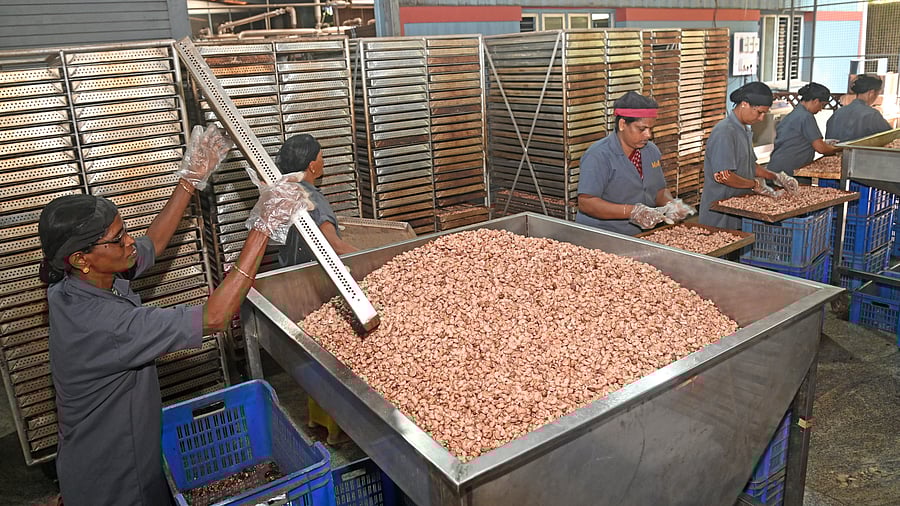
Cashew is grown traditionally in coastal Karnataka with a local output of only around 50,000 metric tonnes per year, while the state’s processing capacity is 4.5 lakh metric tonnes. The rest of the requirement is imported from African countries.
Credit: DH File Photo
Hubballi: While Karnataka is a leading producer of sandalwood, coconut, cashew and cocoa, the Union Budget’s announcement of an initiative to support these ‘high-value’ crops has come at a time when the state is grappling with a shortage of sandalwood, declining coconut yields and heavy dependence on imported cashew and cocoa.
Sandalwood, Karnataka’s state tree, was opened for cultivation by private persons over two decades ago. However, the Karnataka Soaps and Detergents Limited (KSDL), which extracts sandalwood oil and manufactures famed products like Mysore Sandal soap, is experiencing a shortage of sandalwood.
Noting that the initiative will contribute significantly to environmental conservation, carbon sequestration and long-term income security for farmers, All India Sandalwood and Tree-culture Association president K Amaranarayana said sandalwood should be considered as a farm produce, not forest produce.
Sandalwood is grown by farmers on around 11,000 hectares and its cultivation and sale should be deregulated, he said, adding theft and smuggling were major challenges.
According to KSDL managing director Prashanth P K M, KSDL imports nearly 7,000 kg of sandalwood oil, which is 65% of KSDL’s requirement.
The state government is planning to grow more sandalwood trees in forest areas, farmers’ lands and barren government lands.
Farmers and officials admit that coconut yield has come down, citing old trees as the main reason, along with diseases.
Coconut Development Board chief coconut development officer B Hanumanthe Gowda said Karnataka was number 1 in coconut production and second in cultivation area.
The proposed coconut promotion scheme to ‘increase production and enhance productivity through interventions like replacing old and non-productive trees with new ones in major coconut growing states’ would bring focused support, particularly in coastal regions, he added.
“What is important is availability of fertilisers and pesticides at lower prices,” said coconut grower Shankar Murthy of Tiptur taluk in Tumakuru district. Tiptur is a major coconut growing region.
Cashew
It is grown traditionally in coastal Karnataka, while raw cashew is being imported for processing.
Karnataka Cashew Manufacturers’ Association vice president Tukaram Prabhu said the initiative would bring some positive results in five-six years, as it is aimed at making India self-reliant in raw cashew and processing, along with enhancing export competitiveness.
“Cashew processing capacity in the state is 4.5 lakh metric tonnes per year, but the local availability is only around 50,000 tonnes. African countries, from where the cashew is imported, are also now focusing more on processing. Traditional cashew growing area is coming down here, while being introduced in non-traditional areas,” he said.
Cocoa
Mangaluru-based Central Arecanut and Cocoa Marketing and Processing Co-operative Limited (CAMPCO), which also procures cocoa and runs a chocolate factory, imports around 65% of its cocoa requirement. CAMPCO president Satishchandra S R said the new initiative would help cultivate good quality cocoa.
However, agri economist Prakash Kammaradi felt focusing on mere productivity is an outdated argument and no scheme was helpful unless it resulted in better market and prices for crops, increasing farmers’ income.
The budget announcement seemed to be an eyewash, keeping the upcoming elections in Kerala and Tamil Nadu in mind.