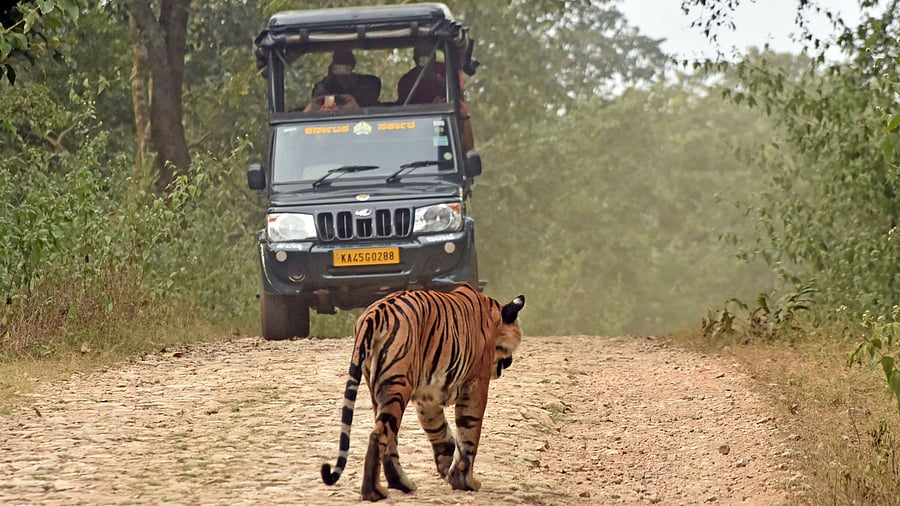
Hubballi: Amid heightened tensions over human-animal conflict, there is a growing demand among wildlife and tribal activists to allow the local Eco-Development Committee (EDC) to operate jungle safaris in tiger reserves of Karnataka.
According to them, the move will provide two major benefits: 1) involvement and livelihood for locals from the forest; 2) The department will get extra hands for performing their primary duty of protection and conservation of forests.
Activists and experts say Karnataka could follow the model adopted by several tiger reserves in India, including Tadoba, Ranthambore, Dhikala, Pench, Bandhavgarh, where local villagers operate jungle safaris, while the forest department monitors the operations.
All the above mentioned tiger reserves are grappling with human-animal conflicts as rise of tiger numbers at these reserves are forcing the big cats to disperse from the protected area and prey on cattle and also accidently kill humans. Yet, there is not much resistance from locals against the presence of big cats, as these villagers are financially benefiting from the presence of tigers.
“Currently, the tribal communities or the villagers living in and around the tiger reserves of Karnataka are not benefiting from the jungle safaris. The fee collected for the safari is utilised by the respective foundations for paying of salaries and other maintenance of forest infrastructure,” said Gopikrishna, president of the Nagarahole Conservation Society. Conservation of forest without the cooperation of tribal and forest dwellers is very difficult, he added.
Gopikrishna pointed out that the National Tiger Conservation Authority (NTCA) guidelines mandate that ecotourism activities, including safaris, be designed to provide direct economic incentives and sustainable livelihoods for local communities so that it fosters community involvement and a shared commitment to conservation efforts. “Currently this is not being followed,” he said.
Allowing tribal people, who are well versed with the forest and behavior of animals, not only provides them financial stability but also ensures that the forest department gets additional hands for its primary duty of protecting and conserving forest.
“Tourism and recreation is not the prime task of the forest department; protection of forest and prevention of wildlife crime is. By allowing EDCs to operate safari we can allow more forest staff for patrolling and forest management activities,” said wildlife activist Joseph Hoover.
But he cautioned that over-exploitation of tourism shouldn’t be allowed even after allowing EDCs. “All the safaris, including those guests of private resorts and JLR, should be operated by tribal and native villagers, while the department officials should strictly ensure entry of vehicles as per the carrying capacity set by the task force,” he says.
An EDC is already operating the jungle safari in Kali Tiger Reserve. Kallu Shiralkar, member of the Pansoli EDC, said there are 20 vehicles being operated by locals and it has improved not just the lives of the driver and naturalists but also the village. “As much as 75% of the total collection from tourism is allocated to EDC. From the additional funds, we are able to provide drinking water storage facilities and solar street lights at our villages inside the protected area,” he said.
Forest Minister Eshwar Khandre said his ministry had not received any proposal in this regard.
“Our government is open to this idea if it helps local people and wildlife,” he said, adding that one-third of the revenue generated by the safari will be used for the welfare of tribal and local villagers.