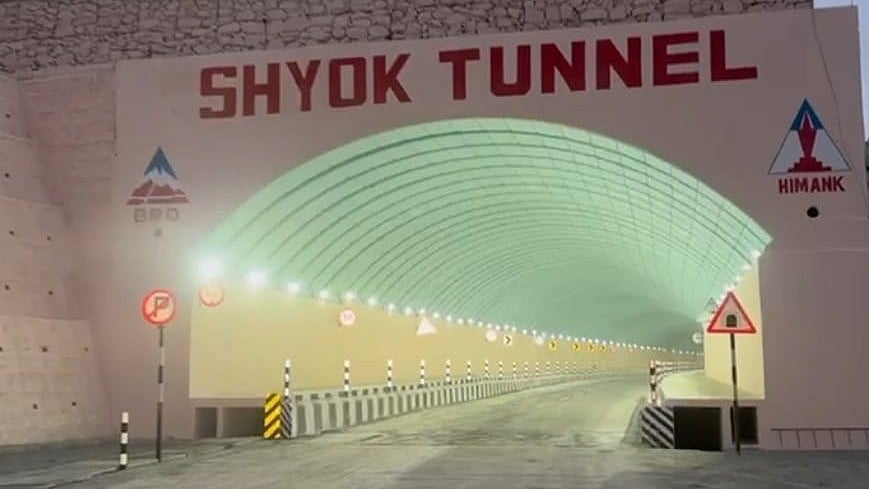
Shyok tunnel
Credit: X/@BROindia
Srinagar: Signaling India’s intent to harden its defences against simultaneous pressures from China and Pakistan, Defence Minister Rajnath Singh on Sunday inaugurated 125 Border Roads Organisation (BRO) projects from eastern Ladakh—India’s largest single-day border infrastructure rollout.
The centrepiece of this push is the Shyok Tunnel, a 920-metre, cut-and-cover structure at over 12,000 feet on the Darbuk–Shyok–Daulat Beg Oldie (DS-DBO) Road, a corridor whose strategic value has surged since the 2020 Galwan Valley clashes.
The tunnel, described by Rajnath as “an engineering marvel built in one of the world’s toughest terrains”, provides all-weather connectivity to forward positions along the Line of Actual Control (LAC).
The DS-DBO axis leads to India’s northernmost military outpost at Daulat Beg Oldie, close to the LAC with China and not far from the Karakoram Pass. BRO engineers say the tunnel will drastically reduce winter disruptions caused by snowfall and avalanches, ensuring a stable logistics chain for troops deployed in the high-friction eastern Ladakh sector.
Linking border infrastructure directly to India’s counter-terror and conventional preparedness, Rajnath invoked Operation Sindoor, launched earlier this year after the Pahalgam terrorist attack.
“Our Armed Forces launched the operation in response to the horrific attack in Pahalgam. Everyone knows what befell those terrorists,” he said. “We could have done much more, but our forces—showing courage and patience—did only what was necessary. Such a massive operation was possible due to our strong connectivity. Logistics reached the forces on time. Our border-area connectivity made the operation a historic success.”
Rajnath praised the coordination between the Armed Forces, civil administration and border residents during the operation, calling it “incredible” and saying this mutualism “is our identity.”
Two-front realities shaping India’s infrastructure push
According to officials, India’s accelerated post-Galwan infrastructure thrust is driven by the strategic reality of facing two hostile neighbours simultaneously—a militarised China along the LAC and an unpredictable Pakistan along the LoC.
The 2020 Galwan clashes, in which 20 Indian soldiers were killed, underscored the need for unfaltering logistics in high-altitude areas. With China continuing forward deployments and talks failing to achieve full disengagement in sectors like Depsang and Demchok, India’s infrastructure strategy now prioritises permanence, survivability and rapid reinforcement.
A message to both Beijing and Islamabad
With India and China still negotiating unresolved stand-offs, and Pakistan-linked militancy posing periodic escalatory risks, the unprecedented BRO rollout signals New Delhi’s willingness to sustain long-term deployment, counter high-altitude vulnerabilities, and strengthen its logistics architecture across both borders.
The Shyok Tunnel, sitting astride the DS-DBO artery, embodies this shift: infrastructure not just as a development priority, but as a strategic instrument of deterrence across a challenging two-front environment.
Largest ever BRO rollout
The 125 projects inaugurated include 28 roads, 93 bridges and four miscellaneous works, spread across two Union Territories—Ladakh and Jammu & Kashmir—and seven states: Arunachal Pradesh, Sikkim, Himachal Pradesh, Uttarakhand, Rajasthan, West Bengal and Mizoram. Valued at around ₹5,000 crore, this is the highest annual addition to BRO’s project portfolio in its history.
“These enhanced capabilities will bring remote villages and forward posts closer to the national mainstream,” Rajnath said, adding that India has shifted from reactive defence to proactive, capability-driven border management along both the LAC and the LoC.
Rajnath also connected border connectivity to economic performance, noting India’s 8.2% GDP growth in Q2 of 2025-26 despite global geopolitical turbulence and India’s own security challenges after Operation Sindoor. Improved communications and roads, he said, drive not just security but long-term economic resilience.