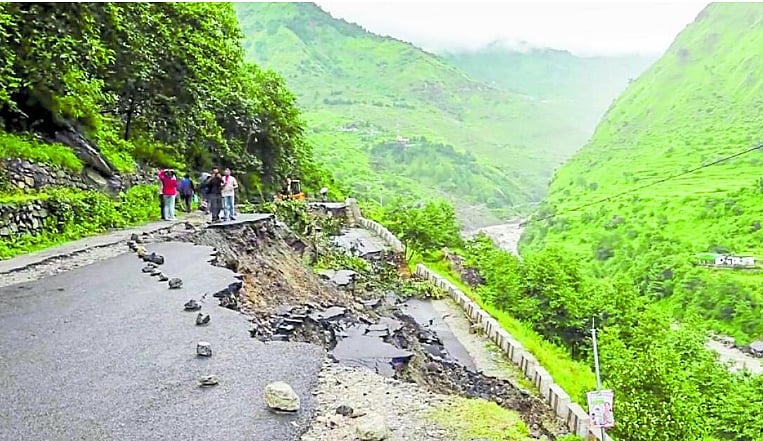
The site after a portion of a road collapsed, near Bhatwari in Uttarkashi district, Uttarakhand.PTI
New Delhi: After its annual general body meeting in March 2019, the Rashtriya Swayamsevak Sangh (RSS) announced it was ready to “take up new initiatives in the field of environment protection and conservation”.
Three months later, the BJP, its political wing, won a second consecutive mandate in Delhi, albeit a bigger one. The continuity in government translated to continuity in policies and programmes, leaving little scope for intervention, even from the BJP’s ideological mentor.
However, RSS chief Mohan Bhagwat has, over the years, in his speeches — especially the annual Vijayadashami address — touched upon environmental degradation, calling upon the need to explore alternative economic models that suit the Indian social milieu.
In 2024, the BJP came to power with a reduced mandate. Its dependence on allies is at an all-time high. Meanwhile, a sure-footed RSS, preparing to celebrate its centenary year, too, has started to calibrate its agenda for the coming decades.
In the last week of August this year, top RSS leaders — including Bhagwat and his deputy Dattatreya Hosabale — attended a closed-door meeting in Delhi with a select group associated with the Sangh. BJP representatives were also in attendance.
In this day-long meeting, the former BJP chief and founding member, Murli Manohar Joshi, gave a detailed presentation on India's economic trajectory. Quoting Nobel laureate Amartya Sen, Joshi reportedly underscored the extreme inequalities engendered by the Western economic models.
Citing natural disasters and flash floods, Joshi, a former Union Minister, also expressed concerns over a “climate emergency”, even as he called upon protecting the Himalayas, the world’s youngest mountain range that offers natural protection to India’s northern frontiers.
Following up on the confabulations, a group of citizens, including Joshi and veteran Congress leader Karan Singh, wrote to the then Chief Justice of India, Justice B R Gavai, a month later, seeking a review of the 2021 apex court order allowing the 825-km Char Dham road expansion project in Uttarakhand, mostly along the Bhagirathi Eco-Sensitive Zone.
In its judgement, delivered by a five-member bench headed by former CJI D Y Chandrachud, the SC had upheld the government’s mandate to broaden three highways — Rishikesh to Mana, Rishikesh to Gangotri, and Tanakpur to Pithoragarh — to facilitate troop movement along the Sino-Indian border.
Urging the courts to protect “whatever little is left to save”, the group — comprising politicians, scientists, and environmentalists — termed the Union government’s stand, under the garb of defence requirements, “unscientific and irrational”.
The letter to the then-CJI cited a study conducted in June this year that pointed out more than 800 landslide zones along the Char Dham route — most created due to the cutting of hills for road-widening.
Backed by the RSS, this ginger group has since crystallised to articulate a cogent alternative development model for India’s hill states, especially Uttarakhand.
“Uttarakhand acquires an important place in the Sangh’s scheme of things because it is home to some of the most revered pilgrimages for the Hindus world over,” said author Arun Anand, who has written on the RSS. “Contrary to the belief that the RSS decides the agenda, it actually picks up issues it feels have a resonance in the masses.”
Joshi and Singh, though they come from different ideological backgrounds, enjoy a certain stature in public life. The combination also lends an apolitical hue to the entire movement.
Allahabad University Physics professor-turned-politician Joshi hails from Almora in Uttarakhand. After Narendra Modi’s ascension in the BJP, he, along with L K Advani, was relegated to the “Marg Darshak Mandal” in an advisory role.
Meanwhile, Karan Singh, who hails from the erstwhile royal family of Kashmir, has long been associated with environmental issues. He was the minister for civil aviation and environment in the Indira Gandhi Cabinet, which launched Project Tiger in 1973.
For its project to protect the Himalayas, the RSS has channelled some of its affiliates working in the field of environment and conservation. The Swadeshi Jagran Manch (SJM), the RSS organ on economy and culture, has also been asked to lend a helping hand.
“Environment and its protection are intrinsically linked to the economic development,” said Ashwani Mahajan of the SJM, who was among the signatories of the petition to the CJI.
To expand the scope and appeal of the initiative, leaders from other political outfits have been invited to participate in the efforts. In the last week of November, another meeting of the ginger group was organised in Delhi. It was attended by RSS joint general secretary Krishna Gopal and ideologue and former BJP organisation secretary Govindacharya. Also in attendance was another Congress leader and former MP from Karnataka, Pradip Tamta.
Speaking at the meeting, Joshi reportedly asked, “Does securing the country mean destabilising the Himalayas? Can’t there be any other way?”
At the end of the day-long meeting, it was decided to file an appeal in the Supreme Court seeking a review of its December 2021 order.