
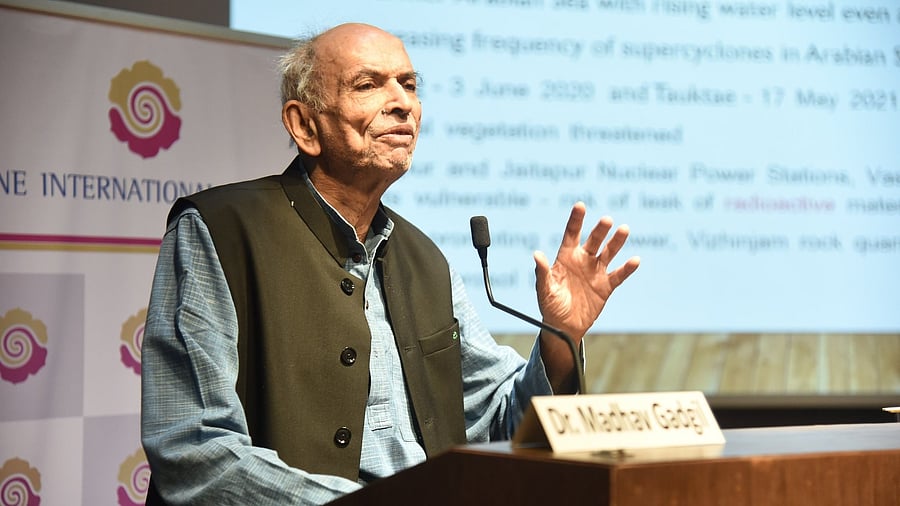
Madhav Gadgil
Credit: X/@PuneIntCentre
New Delhi: Madhav Gadgil’s love for the Western Ghats began in his childhood, thanks to his economist father who exposed the youngster to the serene beauty of emerald green forests. The love affair blossomed over the years and one of India’s most eminent ecologists who died on Thursday at the age of 83, is now best remembered for a much talked-about report that he prepared for the protection of the 1,600 km of mountain range along the western coast.
Gadgil headed the Western Ghats Ecology Expert Panel between 2009 and 2011, and submitted a report recommending protection of 75% of the area, the panel defined as the Ghats spanning across six states.
The recommendations were not acceptable to any of the Chief Ministers, resulting in the formation of a second panel chaired by former Indian Space Research Organisation chairman K Kasturirangan. The Kasturirangan panel brought down the extent of protection to 37% of the Ghat, but even that remained only on papers in the last 11 years.
Within months of coming to power, the Narendra Modi-led NDA government informed the National Green Tribunal that the Gadgil panel’s recommendations would not be followed and the government would go ahead with the Kasturirangan panel’s suggestions. The venerated ecologist was deeply hurt but never stopped campaigning for the Ghats.
Gadgil studied mathematical ecology and fish behaviour at Harvard for six years. Unlike many others who went to study abroad, he returned and worked for two years at the Agharkar Research Institute at Pune before joining the Indian Institute of Science, Bengaluru in 1973 as a faculty member in the Centre for Theoretical Studies, from where he launched several research programmes in ecology and animal behaviour. In 1983, he founded the Centre for Ecological Sciences at IISc to study these topics across the country.
In parallel he has been associated with many key policy initiatives ranging from mapping of the Nilgiri Biosphere Reserve to making of the Biological Diversity Act, 2002 that empowers local communities to value and protect traditional knowledge. He considered indigenous communities as integral part of the ecosystem rather than threats.
“For the policymakers, he was the go to person in conservation. But he always maintained that it's possible for people to coexist with nature and people’s lives are more important,” Raghavendra Gadagkar, a veteran IISc scientist who knew Gadgil since 1973, told DH.
This is the same philosophy that he followed when he was approached by the Karnataka government in the 1990 to assess the Western Ghat project. Gadgil engaged students and teachers from 28 colleges in the Ghat areas for field observations and talking to the locals. The result was a clearer understanding of local issues.
Even while chairing the central panel, he travelled extensively in the Western Ghat with his team interacting with locals before finalising his report.
People were always at the heart of Gadgil’s conservation philosophy. “In the 26 months I was Environment Minister, I turned to him every other day for guidance and advice. We had our differences too. Gadgil didn’t agree with my position on the existing wildlife protection law. He was of the view that a law that didn’t protect the humans was unviable,” said former Union Minister and Congress leader Jairam Ramesh.
His wife Sulochana, also a former IISc scientist and an authority on the Indian monsoon system, passed away in July 2025. Six months later Madhav joins her.