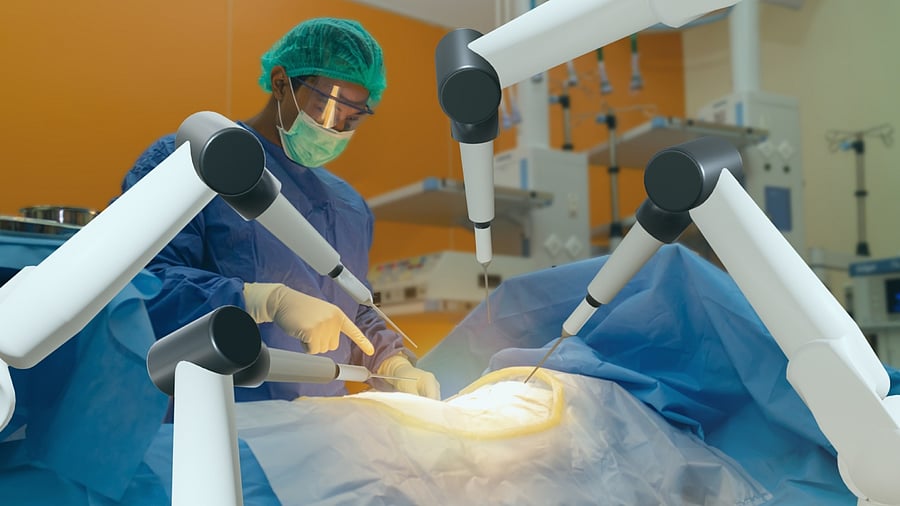
Representative image for surgery
Credit: iStock Photo
Mumbai: In a medical achievement, doctors at Kokilaben Dhirubhai Ambani Hospital in Mumbai, have successfully removed a 550-gram benign (non-cancerous) prostate from a 70-year-old patient using robotic-assisted surgery — marking it the largest prostate gland removed robotically in the world.
The surgery was led by Dr Sanjay Pandey, Director of Urology and Head of Andrology & Reconstructive Urology, who used the da Vinci Xi surgical system to precisely excise the enlarged gland.
The patient had experienced progressive urinary obstruction and recurrent infections for more than six years.
The case was considered high risk due to underlying cardiac comorbidities, a pacemaker implantation and the exceptionally large prostate size, which made traditional open surgery a significantly higher-risk option.
Robotic-assisted surgery allowed the team to perform the procedure without a large abdominal incision and with minimal tissue disruption. The technology offered the precision and control needed to work safely around critical urinary structures in a high-complexity case.
“For very large prostates, traditional minimally invasive procedures can be challenging,” Dr Pandey was quoted saying in a statement. During the procedure, the surgical team first reduced blood flow to the gland and then carefully bisected the prostate within the bladder cavity, with each half weighing around 250 grams and placed in separate retrieval bags for safe removal.
This approach allowed the completion of a minimally invasive surgery for a gland weighing over half a kilogram. Despite its unusually large size, the da Vinci Xi system enabled the surgery to be completed in just 2 hours and 55 minutes, and allowed surgeons with smooth workflow and precise control in such a complex case.
The patient’s family expressed relief at the outcome. “At his age, we were anxious about such a major intervention,” said the patient’s son, who is also a doctor. “Robotic-assisted surgery helped him recover quickly with minimal discomfort, and he has now resumed his routine without complications. We are grateful to Dr Pandey and his team.”