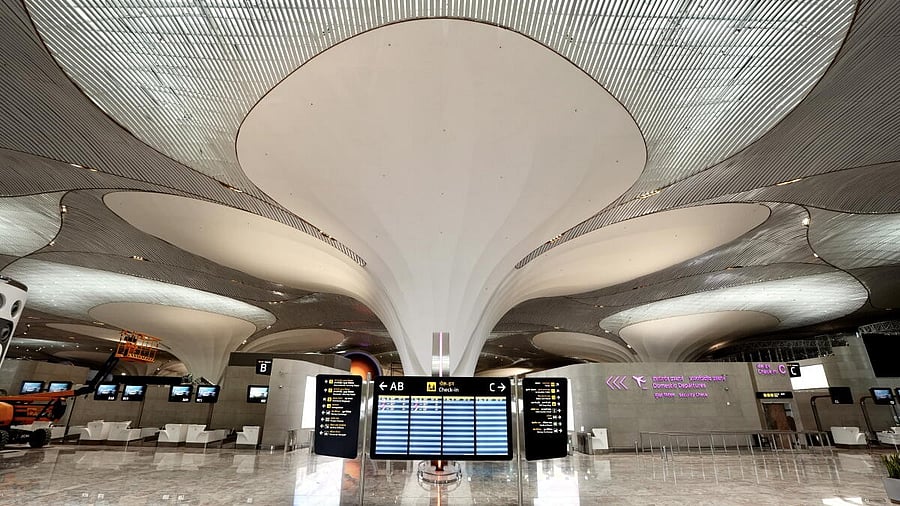
Interiors of the newly-constructed Navi Mumbai International Airport (NMIA) ahead of the inauguration of its first phase, in Navi Mumbai, Maharashtra.
Credit: PTI Photo
Raigad: When the Navi Mumbai International Airport at Ulwe in Raigad district becomes operational on December 25, the spotlight will understandably fall on passenger capacity and connectivity.
Yet, quietly and strategically, NMIA, which falls in the larger Mumbai Metropolitan Region (MMR), is being positioned as something more consequential for India’s economy: a next-generation cargo and logistics gateway designed to power trade, industry and regional growth.
Conceived as India’s first truly multimodal greenfield airport, NMIA has been engineered with cargo at its core.
In its initial phase, the airport will handle 0.5 million tonnes (MT) of cargo annually, scaling up to 3.25 MT in the final phase, placing it among the country’s most significant air cargo hubs.
This capacity expansion is not incremental—it is foundational to supporting India’s ambitions in pharmaceuticals, perishables, manufacturing exports and time-sensitive logistics, NMIA officials said.
It may be noted, the Mumbai International Airport Private Limited (MIAL) and CIDCO established Navi Mumbai International Airport Pvt Ltd (NMIAL), a Special Purpose Vehicle (SPV) to oversee the development, construction, operation and maintenance of the greenfield international airport project in Navi Mumbai.
Subsequently, the Adani Airport Holdings Ltd has taken over the management of NMAIL.
Prime Minister Narendra Modi commissioned the NMIA on 8 October and it is set to launch commercial operations from 25 December, coinciding with the Christmas-New Year festivities.
Pharmaceuticals and perishables are expected to be early growth drivers. NMIA’s cargo terminal includes dedicated temperature-controlled cool corridors, designed to maintain end-to-end cold-chain integrity for vaccines, biologics, seafood, fruits and vegetables.
In a region that already houses major pharmaceutical manufacturers and food-processing clusters, this capability directly addresses one of India’s long-standing logistics gaps: reliable, compliant cold storage linked to air transport.
Beyond perishables, the cargo ecosystem has been planned for diversity and resilience.
NMIA will feature specialised zones for dangerous goods, secured vaults for valuables, dedicated live-animal handling areas and on-site regulatory offices for Customs, Plant Quarantine, Animal Quarantine and the Drug Controller.
International certifications such as Regulated Agent (RA), Regulated Agent Third Country (RA3), Good Distribution Practice (GDP) and the Center of Excellence for Independent Validators (CEIV) further align the airport with global cargo compliance standards, enabling seamless integration with international supply chains.
Strategically located near the Atal Setu (Mumbai Trans Harbour Link) and connected through national highways, urban arterial roads, metro lines, suburban rail and planned water transport, NMIA is designed to compress transit times between factories, warehouses, ports and aircraft.