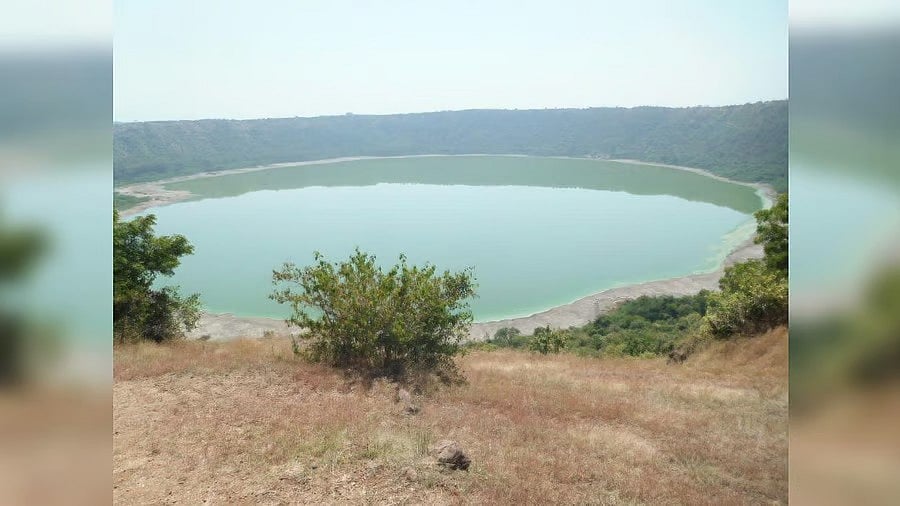
Lonar lake
Credit; DH Photo
Mumbai: The rising water levels at the Lonar Crater, also known as Lonar lake, in the Buldhana district of Maharashtra has come as a major cause of concern.
The Lonar Crater/Lake is listed as a National Geo-heritage Monument and Ramsar Site.
The Nagpur bench of the Bombay High Court has taken cognizance of the reports about the developments.
A division bench comprising Justice Anil Kilor and Justice Raj Wakode court ordered filing of a suo motu PIL and appointed Advocate Mohit Khajanchi as the amicus curiae.
The Lonar lake is a Ramsar site is a wetland recognised under the Ramsar Convention, an international treaty for the conservation and sustainable use of wetlands, of which India is a signatory.
The rising water has submerged some of the temples. More than a dozen temples are located here which include the Daitya Sudan Temple, Vishnu Temple, Shiv Temple, Gomukhi Temple and so on.
The phenomenon, observed over the past few years, has prompted the district administration to seek expert inputs from the Indian Institute of Technology-Bombay to determine the reasons behind the rising water level.
The crater-lake was formed nearly 52,000 years ago when a meteorite slammed the Deccan Plateau. The meteorite weighed two million tonnes and was travelling at an estimated speed of 90,000 kmph. It created a hole which was 150 m deep and 1.8 km wide!
Scientists believe that the energy released during this event was equivalent to a six-megaton atom bomb explosion.
The collision led to the formation of one of the largest, most unique basalt impact craters in the world. It has a mean diameter of 1.2 km and is about 137 m below the crater rim. The meteor crater rim is about 1.8 km in diameter.
The Lonar site includes the lake as well as escarpments, which form the crater walls, and forested zones. The lake is high in salinity and alkalinity, as the lack of an outflow leads to a concentration of minerals as the lake water evaporates.
Certain microorganisms such as anaerobes, cyanobacteria, and phytoplankton survive in this harsh chemical environment.
Outside the lake, there is considerable diversity of plant and animal life, like springs which help feed the lake and provide a source of freshwater. Inhabiting the site are 160 species of birds including the vulnerable Asian woolly-neck (Ciconia episcopus) and common pochard (Aythya ferina), 46 species of reptiles, and 12 species of mammals including the iconic grey wolf (Canis lupus).
Both these sites are both threatened by household sewage and urban wastewater and by unsustainable tourism.
The Smithsonian Institution, the United States Geological Survey, Geological Survey of India, the University of Sagar, and the Physical Research Laboratory have conducted extensive studies of the Lonar site. Biological nitrogen fixation was discovered in this lake in 2007. A 2019 study, conducted by IIT Bombay found that the minerals, in the lake soil, are very similar to the minerals found in moon rocks brought back during the Apollo programme.