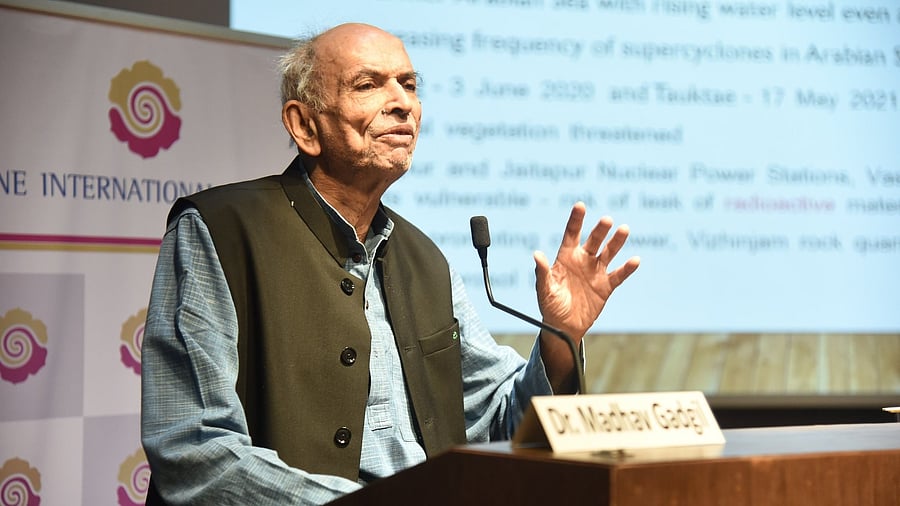
Madhav Gadgil
Credit: X/@PuneIntCentre
Mumbai: Veteran ecologist, environmentalist and writer Madhav Gadgil, who drafted the thought-provoking iconic report on the Western Ghats, passed away in Pune on Wednesday night. He was 83.
Gadgil was the strongest advocate for balance between people, nature and development.
Gadgil was a former member of the Scientific Advisory Council to the Prime Minister and the head of the Western Ghats Ecology Expert Panel (WGEEP) of 2010, popularly known as the Gadgil Commission.
Gadgil, a recipient of the coveted Padma Shri and Padma Bhushan awards, was one of the architects of the Biological Diversity Act and was involved in the implementation of the Forest Rights Act.
Gadgil is known to have done extensive research in the areas of population biology, conservation biology, human ecology and ecological history.
His research has been documented by over 250 scientific articles published in various national and international journals and magazines.
He was born on May 24, 1942, in Pune, to Pramila and Dhananjay Gadgil, a Cambridge scholar, economist, former Deputy Chairman of Planning Commission and former director of the Gokhale Institute and the author of the Gadgil Formula.
In 1963, Gadgil completed BSc (Zoology) from the Fergusson College of Poona University, now known as Savitribai Phule Pune University, Pune.
Later, in 1965, he completed MSc (Zoology) from Harvard University and in 1969 completed PhD (Biology) from Harvard University.
In 1971, he returned to India and took up a job at Agharkar Research Institute in Pune, where he worked for a couple of years.
In 1973, he joined the Indian Institute of Science in Bengaluru, where he worked for close to 30 years, superannuating as its chairman in 2004.
Gadgil had served in various capacities, including being a member of National Council of Educational Research and Training (NCERT) and a member of the National Tiger Conservation Authority (NTCA) and a member of National Advisory Council (NAC).
Besides the two Padma awards, Gadgil had been conferred with the Volvo Environment Prize and the Tyler Prize for Environmental Achievement.
In 2024, the United Nations presented Gadgil with the annual 'Champions of the Earth' award, the UN's highest environmental honour, for his seminal work on the Western Ghats, a global biodiversity hotspot and a UNESCO World Heritage Site.
A sports lover, held the Maharashtra State Junior and Pune university high jump records in 1959 and 1961, respectively. He also represented Pune university at the All India University Athletic meet.
'Architect of the biodiversity law in India'
"Gadgil did not limit himself merely to writing and enlightenment but also engaged in practical work on how to utilise natural resources accurately. He emphasised the participation of local communities in this. The work he did for the conservation of the Western Ghats is particularly noteworthy. He must be mentioned as the architect of the biodiversity law in India,” Maharashtra Chief Minister Devendra Fadnavis said.
'His influence on public policy has been profound'
“Gadgil’s influence on public policy has been profound going back to his crucial role in the Save Silent Valley Movement in the late 70s and early 1980s. His intervention to protect forests in Bastar was crucial in the mid -80s. Later, he gave shape to a new direction to the Botanical Survey of India and the Zoological Survey of India. During 2009-2011, he chaired the Western Ghats Ecology Expert Panel and wrote its report in a most sensitive and democratic manner that remains unmatched in both substance and style,” said senior Congress leader and former Union Environment and Forest Minister Jairam Ramesh.