
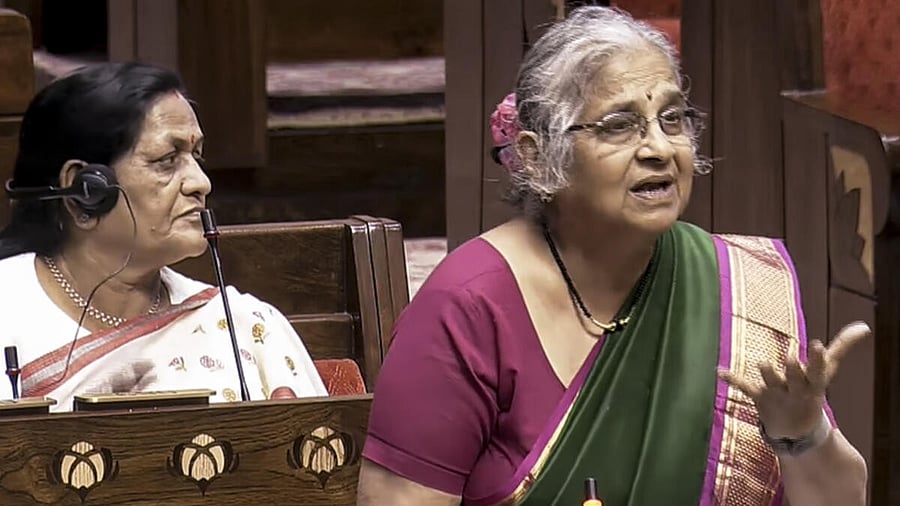
Sudha Murty
Credit: Sansad TV via PTI Photo
New Delhi: Nominated Rajya Sabha MP Sudha Murty is all set to move a Private Members Resolution in the Upper House seeking to make free and compulsory early childhood care and education, including pre-primary learning, a fundamental right.
The resolution, which is listed for discussion on Friday, urges the government to take suitable measures to enhance further the delivery, training, and support systems related to early childhood services, recognising their central role in securing strong foundations for lifelong learning and development.
In her resolution, she refers to Article 21A of the Constitution that guarantees free and compulsory education to children between six and 14 years of age and the Constitution (86th Amendment) Act, 2002 that introduced a Directive Principle encouraging the State to provide early childhood care and education (ECCE) to children below six years of age.
On these lines, she urges the government to consider taking steps to amend the Constitution to introduce a "new Article 21B guaranteeing free and compulsory early childhood care and education, including nutrition, health services, and pre-primary learning, for all children between three to six years of age".
She also wants the government to work towards universal access to quality ECCE through strengthened anganwadi services or through any other mechanism the government may deem appropriate, to ensure that all children receive equitable and holistic early childhood support.
Emphasising the need for making early childhood care and education a fundamental right, the resolution says that the availability of high-quality, safe and accessible childcare "allows mothers, siblings and grandparents to engage in more productive economic activity", contributing to increased household incomes and greater Female Labour Force Participation.
Murty argues in her resolution that early childhood, from birth to six years, is a critical developmental period, during which over 85 per cent of brain development occurs. She also says that National Education Policy (NEP) 2020 recommends universal, high-quality ECCE by 2030 and underscores the importance of strong investment in it for improved long-term learning and well-being.
She says screening of all children for disabilities and developmental delays facilitates early diagnosis and intervention, inclusive practices in early learning, and timely referral to medical and disability specialists, contributing to the de-stigmatisation and possible prevention of lifelong disability.
Murty reminds that the the delivery of ECCE is closely linked to India’s international commitments towards meeting Sustainable Development Goal 2 (Zero Hunger) and Sustainable Development Goal 4 (Quality Education), as well as the Convention on the Rights of the Child, 1989 and the Tashkent Declaration and Commitments to Action for Transforming ECCE, 2022.