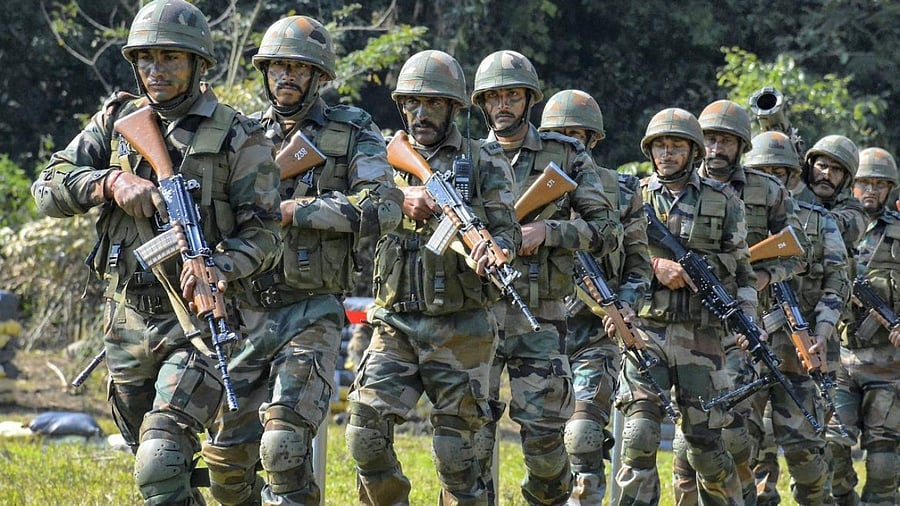
File photo of Indian army personnel (Representative image)
Credit: PTI Photo
Shillong: There was constant pressure on India's eastern border with China, even though most of the action happened along the western frontier, a senior Indian Air Force (IAF) official said on Thursday.
Air Officer Commanding-in-Chief (Eastern Air Command) Air Marshal Inderpal Singh Walia and a few other senior personnel interacted with a delegation of journalists from Karnataka who are touring Meghalaya.
During the interaction, a senior officer explained the nuances of border disputes: "There are regions we think are ours. There are regions they think are theirs. There are also regions which they think we think are (consider) ours."
Responding to a question about the geographic and other differences between the eastern and western parts of the Indo-China border, the above-mentioned official explained that the eastern part in Arunachal Pradesh had a hilly terrain, where it was harder to move tankers, while the terrain in Ladakh was flat.
When the infantry (foot soldiers) navigated through hilly terrains, support from the IAF was deemed crucial.
He noted that the entire Indo-China border came under the Western Theatre Command in the Chinese army (in India, it comes under Northern, Central, and Eastern Army Commands), providing China with a single-window command.
"There are many points of dispute along the border, and it's impossible to start a battle at all these places. The Chinese army (People's Liberation Army) may target a particular point," said the official.
Earlier, in a presentation to journalists, another officer explained that the Chinese had a flatter plateau on their side of the eastern border, unlike the Indian border in Arunachal Pradesh. "However, the terrain gets hilly around the border even for them in places where clashes are likely," said this official.
The senior officer quoted at the beginning felt the coverage of wars by the Indian media was "better than many countries", adding: "Most of the news broadcast and covered by the Indian media during Operation Sindoor was accurate."