
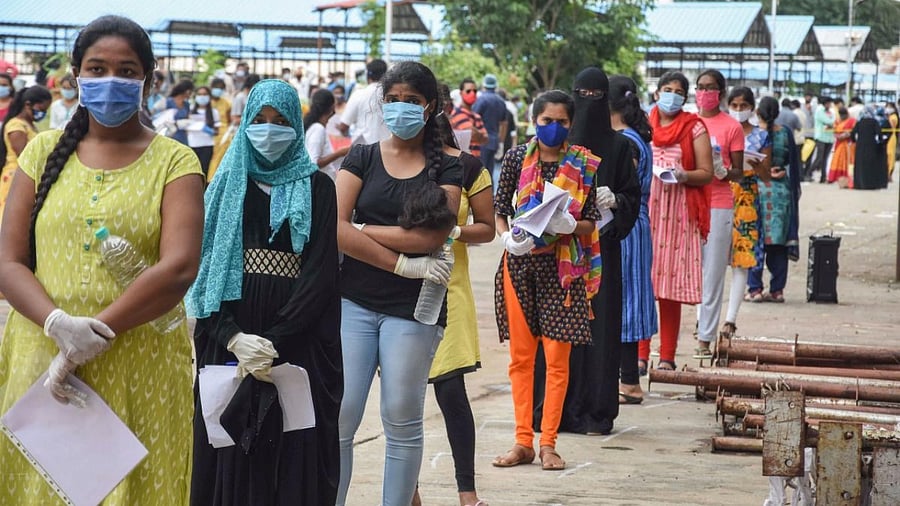
Representative image of NEET-PG aspirants.
Credit: PTI Photo
New Delhi: Five months after the results of NEET-PG were announced, more than 18,000 post graduate medical seats remain vacant, forcing the National Board of Examinations in Medical Sciences to lower the qualifying norms further and allowing a section of students with negative cut-off scores to become eligible.
According to the NBEMS notification, the eligibility cut-off score for students from SC/ST/OBC category is minus 40 out of 800 while the same for general students is 103. For students with disabilities, the cut-off mark is 90.
The NBEMS notification has triggered a controversy with a section of doctors being critical of the testing body.
Two associations – the Federation of All India Medical Association (FAIMA) and Federation of Resident Doctors Association (FORDA) on Wednesday wrote to the Union Health Minister J P Nadda seeking to withdraw the notification and “restore a reasonable, merit-based cut-off in the larger interest of patients, medical education, and public trust”.
Sources told DH the eligibility criteria for reserved category students had negative marks in the last two years too.
India has 1,23,700 MBBS and 76,174 seats for 2025-26 academic season. Since the number of PG seats are less, a merit list is prepared on the basis of the NEET-PG score.
“NEET PG is a competitive entrance test to build up a merit list, since seats are much lower than aspirant students. Here we are not changing the scores of the students and the biggest reason for the negative score is due to the structure of the examination with negative marking for wrong answers,” sources said.
The revision, according to sources, aims to ensure optimal utilisation of available seats that are vital for expanding India’s pool of trained medical specialists.
Leaving such seats vacant undermines the efforts to improve healthcare delivery and results in the loss of valuable resources. All NEET-PG candidates are MBBS-qualified doctors who have completed their degrees and internships.
Asked about the vacancies in the PG seats, Rohan Krishnan, chief patrol of FAIMA said exorbitant fees charged by private medical colleges and poor training standards in many were the key contributing factors behind the vacancy.
“In several private medical colleges, the fee for a single PG seat runs into crores of rupees, making it unaffordable even for meritorious candidates. Students are avoiding institutions where training quality is poor but financial burden is crushing,” Krishnan said.
“Instead of correcting these systemic failures, authorities are lowering eligibility standards — which is a dangerous shortcut. This (negative cut-off score) is deeply alarming, because it implies that minimum competence is no longer being treated as essential to become a specialist doctor,” he added.