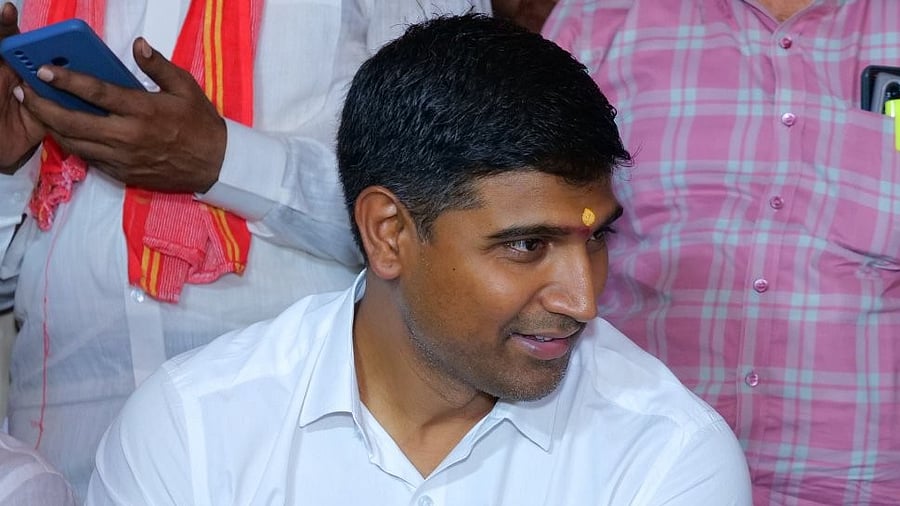
MP Lavu Sri Krishna Devarayulu.
Credit: X@/@SriKrishnaLavu
Hyderabad: NDA ally TDP supported the Vikas Bharat–Garib Kalyan (VB-GRAM-G) Bill, which was passed in the Lok Sabha on Thursday. However, the party stressed that as a revenue-deficient state, Andhra Pradesh faces challenges in contributing the mandatory 40% state share for centrally sponsored schemes. The TDP sought continued and enhanced central support similar to what has been extended over the past one-and-a-half years to ensure effective implementation of welfare schemes in the state.
Meanwhile, the opposition YSRCP urged the Union government to refer the Bill to a Select Committee or a Joint Parliamentary Committee, arguing that such legislative scrutiny is vital to protect the guaranteed employment rights of millions of rural households.
“The central theme repeatedly mentioned in this House is change, which is the only constant in governance and public policy. The changes being introduced reflect evolving aspirations of the people, shifts in the economy, and developmental progress witnessed over the last 15 years. Every decade has had its own defining focus, the 1960s on nation-building, the 1970s on Garibi Hatao, the 1980s on Roti Kapda Makaan, the 1990s on liberalisation, the 2000s on the right to work, the 2010s on Sabka Saath Sabka Vikas, and the 2020s on Atmanirbhar Bharat. As economic conditions improve, schemes must also evolve, especially when poverty has declined from 25% in 2011–12 to 4.8% in 2023–24,” said TDP MP Lavu Krishnadevarayalu during the debate in Lok Sabha on the Bill.
He added that rural employment programmes have existed since 1969 in multiple forms and iterations, long before MNREGA was introduced in 2005.
Over the decades, schemes such as the Rural Employment Programme, Jawahar Rozgar Yojana, and Jawahar Gram Samriddhi Yojana eventually culminated in MNREGA. The current proposal is another necessary iteration in 2025, reflecting new economic realities and implementation experiences, he added.
“Based on recommendations, feedback, and monitoring outcomes, the government has proposed increasing guaranteed employment from 100 to 125 days. Budgetary allocation has increased substantially from Rs 5,400 crore at the inception of the scheme to nearly Rs 86,000 crore in recent years, with exceptional enhancement during the COVID period. While the scheme played a critical role during periods of distress, it now requires restructuring, better targeting, and reform to remain effective. The proposed changes are therefore timely and necessary,” he said.
The TDP MP also submitted to the concerned ministry five key suggestions for improving the scheme including the need to strengthen legal provisions to prevent fraud under NREGA, increase in the number of technical assistants, reforms in wage indexation, shift towards creation of durable assets under the amended law and strengthening of social audits.