
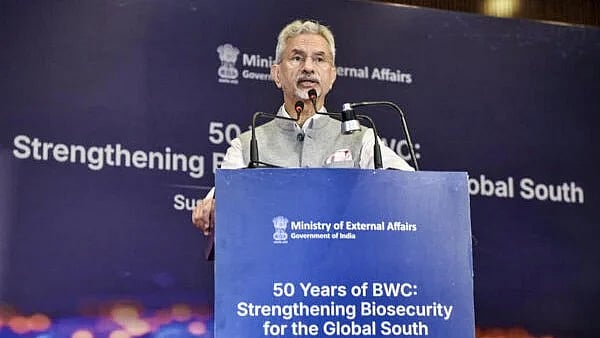
External Affairs Minister S. Jaishankar addresses a conference on '50 Years of the Biological Weapons Convention: Strengthening Bio-security for the Global South', in New Delhi
Credit: X
New Delhi: Bioterrorism is no longer a distant possibility, External Affairs Minister S Jaishankar said on Monday, calling for modernisation of the 50-year-old Biological Weapons Convention (BWC), which still lacks basic institutional structures, a compliance system, a permanent technical body or a tracking mechanism for new scientific developments.
“India has consistently called for stronger compliance measures within BWC, including verification designed for today’s world,” External Affairs Minister S Jaishankar said, adding: “India supports international cooperation and assistance enabling exchange of materials and equipment for peaceful use. We have further called for a systematic review of scientific and technological developments so that governance does indeed keep pace with innovation.”
The external affairs minister was speaking at a conference held in New Delhi on “50 Years of the Biological Weapons Convention: Strengthening Biosecurity for the Global South”.
He noted that developments in science and technology were outpacing the existing governance and normative frameworks.
The scientific tools are evolving faster than global rules, he said, underlining: “Synthetic biology, genome editing, and AI-driven design make biological manipulation easier than ever.”
“We have long highlighted concerns relating to advancements in science and technology that have implications for international security and disarmament through annual resolutions in the UN General Assembly First Committee. Another resolution by India, adopted by consensus, is ‘Measures to prevent terrorists from acquiring WMD’.”
The BWC – officially known as “Convention on the Prohibition of the Development, Production and Stockpiling of Bacteriological (Biological) and Toxin Weapons and on their Destruction” – entered into force on March 26, 1975. Over 180 nations, including India, China and the United States, signed the treaty.
“For 50 years,” the external affairs minister said, “BWC has stood by one simple idea: that humanity rejects disease as a weapon. But norms survive only when nations renew them. The next 50 years will demand concerted action. We must modernise the Convention, we must keep pace with science and strengthen global capacity so that all countries can detect, prevent, and respond to biological risks. India stands ready.”
New Delhi has been asking for negotiation of a comprehensive and legally binding protocol, providing for an effective, universal and non-discriminatory verification mechanism to strengthen the implementation of the convention by State Parties, ensuring full compliance and deterring non-compliance with it. India has also been highlighting the dangers from the possible use, in future, of microorganisms as biological weapons by terrorists through its annual Resolution at the UN General Assembly, titled ‘Measures to prevent terrorists from acquiring weapons of mass destruction’.
“Misuse” of developments in biological science by “non-state actors” is “no longer a distant possibility”, Jaishankar said on Monday, underlining that the international community must be adequately prepared for dealing with bioterrorism. “Yet the BWC still lacks basic institutional structures, as we were just reminded. It has no compliance system; it has no permanent technical body and no mechanism to track new scientific developments. These gaps must be bridged in order to strengthen confidence.”