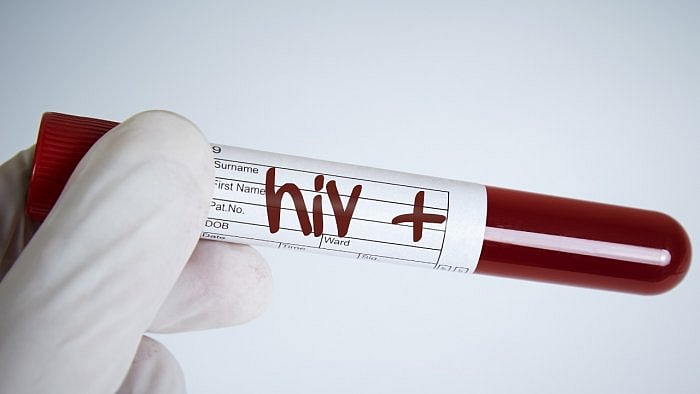
Image for representational purposes.
Credit: iStock Photo
New Delhi: India achieved 48.7 per cent decline in annual new HIV infections and 81.4 per cent reduction in AIDS-related deaths between 2010 and 2024, according to government data.
There has been a 74.6 per cent decline in mother-to-child HIV transmission, the data stated.
The HIV epidemic in India remains low nationally, with new infections and AIDS-related deaths declining faster than the global average, stated the India HIV estimation 2025 report.
All the same, certain states had a rising epidemic, potentially due to injecting drug use and casual heterosexual behaviour, it said.
"India is on track to attain SDG 3.3 of ending HIV-AIDS as a public health threat by 2030," the report said.
According to it, India had around 25.61 lakh people living with HIV (PLHIV) in 2024 with Maharashtra (3.99 lakh) having the highest number of them, followed by Andhra Pradesh (3.10 lakh) and Karnataka (2.91 lakh).
Of the total number, 13.97 lakh were male and 11.64 lakh were female.
Uttar Pradesh, Tamil Nadu, Telangana, Bihar, Gujarat, and Punjab have between 1 lakh to 2 lakh PLHIV.
Together, these nine states have 74 per cent of the total PLHIV burden in India.
An annual new HIV incidence rate per 1,000 uninfected population was estimated at 0.05 (UB-0.03-0.08) nationally - males 0.05 and females -0.04.
The incidence rate was 0.06 among the young population.
Mizoram had the highest estimated HIV incidence per 1,000 uninfected population, followed by Nagaland and Tripura, the report said.
Punjab, Arunachal Pradesh, and Meghalaya were other states with an incidence rate of 0.20 or higher.
Annual new cases were estimated to decline nationally by around 48.70 per cent between 2010 and 2024 but increased by more than 400 per cent in Arunachal Pradesh and Tripura, Globally, annual new infections had declined by 40 per cent between 2010 and 2024.
Annual AIDS-related mortality rate per 100,000 population was estimated nationally at 2.32 (men -2.91 vs women 1.70).
AIDS-related mortality per 100,000 population was highest in Manipur (15.49 ), Mizoram (10.88), and Nagaland (7.59), the report stated.
Annual AIDS-related deaths declined by 81.40 per cent between 2010 and 2024 in the country.
Such deaths have declined between these 14 years in nearly all states and UTs, except in Chandigarh, Punjab, Arunachal Pradesh and Tripura, where more PLHIV died due to AIDS-related causes during 2024 as compared to 2010, it said.
Globally, annual AIDS-related deaths had declined by 54 per cent between 2010 and 2024.
According to officials, India continues to demonstrate substantial progress under the current phase of the National AIDS Control Programme.
HIV testing increased from 4.13 crore (2020-21) to 6.62 crore (2024-25), while access to antiretroviral treatment rose from 14.94 lakh to 18.60 lakh PLHIV in the same time period.
Viral load testing nearly doubled from 8.90 lakh to 15.98 lakh in the same period.