
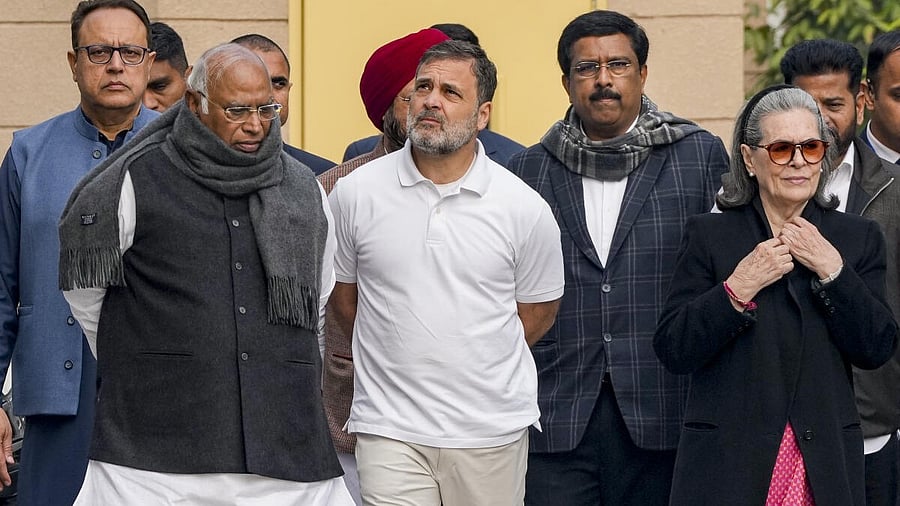
Congress President Mallikarjun Kharge with LoP in the Lok Sabha and party leader Rahul Gandhi, party MP Sonia Gandhi and others arrives for the Congress Working Committee (CWC) meeting, in New Delhi, Saturday, Dec. 27, 2025.
Credit: PTI Photo
New Delhi: The Congress is heading to a new year with the same set of challenges it faced in 2025 – from questions over its organisational set up to electoral prospects, diminishing hold on alliance partners and resistance to central leadership’s narrative with a section running their own agenda.
It will also have to deal with the simmering tension in Karnataka where Chief Minister Siddaramaiah and his deputy DK Shivakumar are at loggerheads over leadership role besides an anticipated fight for leadership role in poll-bound Kerala where the party hopes to unseat its national ally CPI(M).
By 2024 year-end, the party had thrown away the political advantage it gained by reducing the BJP to 240 seats in Lok Sabha with electoral setbacks in Maharashtra and Haryana and it could not regain its mojo either in Delhi early this year or in Bihar later 2025.
The central leadership’s inability to rein in warring leaders in states are impacting its forward movement even as the organisational revamp programme made some headway by appointing new district presidents though committees at the ground-level are yet to be set up.
The uneasiness over the organisation revamp programme among a section of leaders was highlighted by senior leader Digvijaya Singh first through a tweet and through his intervention at the Congress Working Committee meeting last Saturday.
Organisational troubles were the reason for the Congress’ poor show in Delhi, where it managed a zero for third time after running a high decibel campaign, and in Bihar where it was reduced to six in one of its worst performances.
Bihar polls also raised the question of choice of party’s poll and political narrative centred around ‘vote chori’, vociferously advocated by Leader of Opposition in Lok Sabha Rahul Gandhi.
While the Congress’ official analysis of Bihar results put the blame on ‘vote chori’ and Special Intensive Revision, a section of leaders had argued that jobs and livelihood issues should have been the centre of its campaign, as ‘vote theft’ could not attract voters.
Rahul had faced resistance from a section of leaders over his insistence on Caste Census before the government announced to hold caste count along with General Census as well as ‘vote chori’. The party has also now opened a new front on MGNREGA but a section of leaders are sceptical about its potential like the three farm laws had.
Add to this – the leaders like Shashi Tharoor defying the leadership on issues like ‘Operation Sindoor’ and MPs like Imran Masood projecting Priyanka Gandhi Vadra as a possible Prime Ministerial choice, giving a handle to the BJP to claim a vote of no confidence in Rahul’s leadership.
The Assembly elections to five states and union territories also throw a challenge to the Congress. While it is not the principal player in West Bengal and Tamil Nadu, Congress performance in Kerala, Assam and Puducherry will be keenly watched and if it does not manage to win at least one of these, it may trigger another fight between leaders of different generations.
A senior Congress MP summed up: there are 2-3 generations of leaders in the party and the seniors are unwilling to cede space and privileges. “They want to decide everything and we are unable to get new blood in leadership,” the leader said.
The other day party chief Mallikarjun Kharge warned those who think that Congress is “finished” and said “Congress is an ideology and ideologies never die”, but it is to be seen how it navigates the choppy waters this year.