
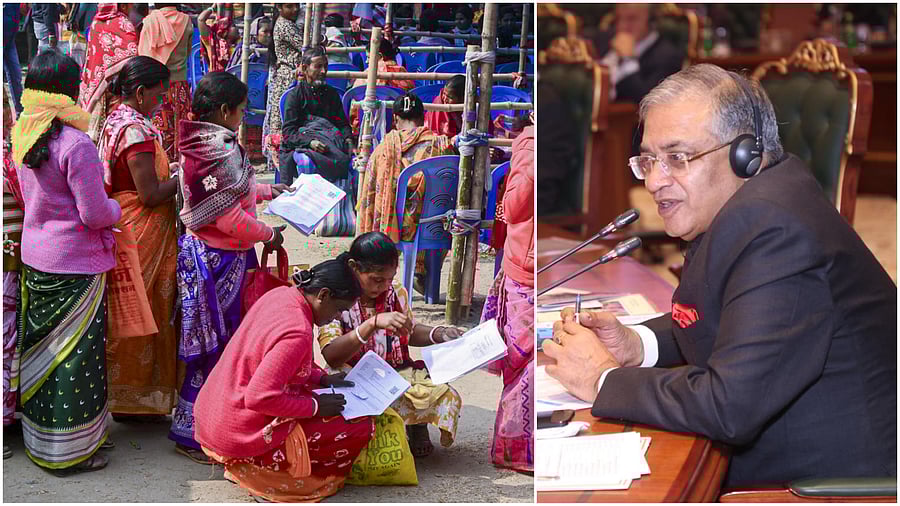
People wait in queues at a centre during hearings under the Special Intensive Revision (SIR) of electoral rolls in West Bengal; Chief Election Commissioner Gyanesh Kumar (R).
Credit: PTI Photo, X/@ECISVEEP
New Delhi: Chief Election Commissioner Gyanesh Kumar on Wednesday showcased the Special Intensive Revision and subsequent election in Bihar to highlight India’s robust electoral system before international poll management bodies, saying no appeal was filed after the "purification of the electoral rolls" and no repolls were required after the voting.
Inaugurating the India International Conference on Democracy and Election Management 2026, he said the Booth Level Officer (BLO), the ground-level functionary who helps in preparing electoral rolls, is the foundational pillar of electoral democracy in the country.
His comments on the Bihar SIR came amid the Opposition questioning the exercise, which has now been extended to 12 other states and union territories, while alleging that it is an exclusionary exercise aimed at deleting names of voters from existing rolls.
"Bihar went for elections a few months back. The first step was purification of electoral rolls, including eligible electors. That stage got completed and under electoral laws there is a provision for the electoral of any Assembly segment to file appeal, so that no wrong name gets included and no right name gets excluded, and you will be amazed with the efficiency of the BLOs, the Electoral Registration Officers and the Chief Electoral Officer of Bihar that out of 75 million electors, the number of appeals were zero," he said.
"Another feat which was achieved in Bihar elections...there were nearly a lakh polling stations...how many repolls were required -- zero. That was the level of accuracy of efficiency, which was attained by our returning officers, sectoral magistrates and presiding officers in each and every booth," he said.
Emphasising that pure electoral roll is essential to strengthen democracy, he said a great level of efficiency was achieved by the local poll machinery from purification of rolls to the conduct of elections.
International Institute for Democracy and Electoral Assistance (International IDEA) Secretary General Kevin Casas-Zamora said the context in which elections take place has changed dramatically in the recent years with political polarisation, illicit funding flow, aggression both online and offline and digital disinformation supported by obscure algorithms and bots disrupting polls globally.
"Perhaps most concerning outright election denial is spread around the world with politicians from US to Peru and from Georgia to Bangladesh using spurious arguments to question credible election results. Trust is the key feature of any effective election. Yet, trust in elections is being eroded. Many voters in many countries feel apathy, skepticism or both," he said.
In 2024, he said the world saw the greatest round of elections in history with around 1.6 billion people casting ballots in 74 national elections, including in India. However, he said the global turnout was nearly 10 percentage points lower when compared to 15 years before while 40% of elections suffered some form of dispute over the credibility from legal boycotts to complaints about outcome.
"Threats to elections are only half of the story. Equally important is that despite so many challenges, elections are resilient. Amid broad democratic backsliding, elections continue to offer an opportunity to renew...to reverse the democratic backsliding in cases like Poland, Slovenia, Senegal, Guatemala and Brazil. It happened because of an election. Democracy can be restored as long as the electoral route for political change remains open. Protecting electoral integrity is thus vital for democracy," he said.
He said the global spread of democracy which was once viewed as inevitable has not just stalled but it is regressing. "Headlines of past months have belied any presumption that the cause of democracy will be sustained by the same countries that led the charge for the past 80 years or so. If democracy is to be resilient, if democracy is to be renewed, then we need new champions to carry the torch. That is why India's leadership is so welcome," he added.