
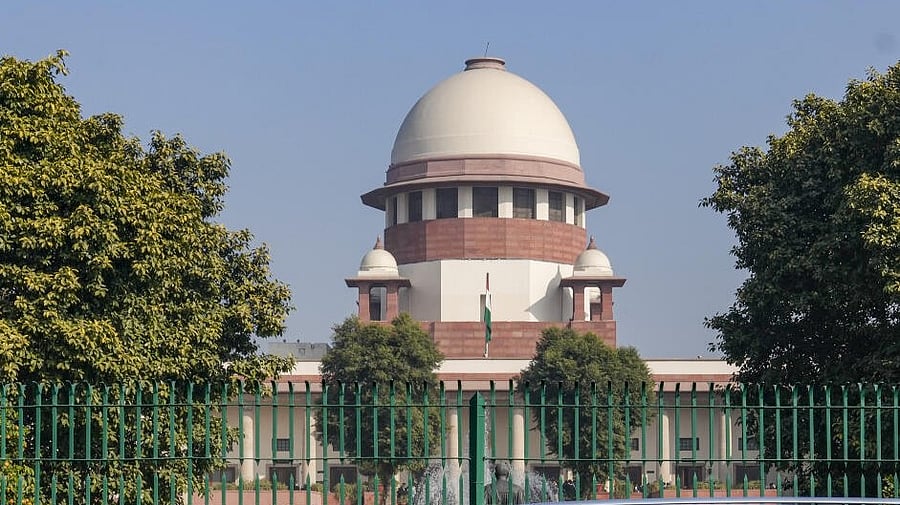
Supreme Court of India.
Credit: PTI Photo
New Delhi: The Supreme Court has set aside the Andhra Pradesh High Court's orders quashing multiple FIRs in corruption cases solely on the issue of lack of jurisdiction of the police station, calling it "nothing but a travesty of justice'".
A bench of Justices M M Sundresh and Satish Chandra Sharma said, a helping hand, extended by the High Court through a hyper-technical approach, nullified the FIRs for offences committed under the Prevention of Corruption Act, 1988, which left the investigations being nipped in the bud in some cases, while, in the others, criminal proceedings stood terminated.
"We make it clear that the High Court of Andhra Pradesh shall entertain no more challenge to the FIRs," the bench said in its judgment on January 8, 2026.
In its judgment, the High Court held that, in the absence of a notification under Section 2(s) of the CrPC, 1973, the police station, to which the police officers who registered the FIRs belong to, do not have any jurisdiction.
In fact, the High Court has completely misdirected itself while interpreting the law, including the principles laid down by this court, the bench said.
Acting on petitions filed by respondent accused in a batch of FIRs, the bench felt, "The High Court took undue pains to ensure that the FIRs are quashed.''
Upon hearing senior advocates Sidharth Luthra and Siddharth Aggarwal for the state authorities, who contended that High Court's approach cannot be sustained in the eyes of the law, the court allowed the appeal by the Joint Director (Rayalseema), Anti-Corruption Bureau, Andhra Pradesh.
"If, on a hyper-technical ground, the FIRs are quashed, the High Court is duty-bound to lay down the law with respect to the jurisdiction that otherwise exists," the bench said.
The bench said, the High Court's reasoning, that a declaration by way of a notification has to be published in the Official Gazette for due compliance of Section 2(s) of the CrPC, 1973, after reorganization of the state of Andhra Pradesh is, "to say the least, unacceptable".
The appellants' counsel said, after the advent of the 2014 Act, it cannot be contended that the Joint Director, Central Investigating Unit, ACB, Hyderabad would continue to have jurisdiction. Perhaps, he will have jurisdiction qua the State of Telangana.
Subsequent to the reorganisation of the state, it should be deemed that the office, which stood relocated to the new capital, continued to have jurisdiction over the entire State, the counsel said.
They said, the High Court has not adopted a pragmatic approach, while ignoring the earlier decisions of this court.
Agreeing to the submissions, the bench said, "One has to see the substance and due compliance, in spirit. Similarly, the finding, that the subsequent clarificatory Government Order of 2022 will not have an effect on the FIRs registered, is totally untenable and against the basic canons of law."
The bench said that the 2003 government order, which declared ACB offices as police stations and conferred statewide jurisdiction on the Joint Director, Central Investigation Unit, continued to have the force of law even after the bifurcation of the erstwhile State.
The court said, the relocation of the ACB’s Central Investigation Unit from Hyderabad to Vijayawada did not divest it of jurisdiction, particularly in view of the deeming provisions under the 2014 Act and binding Government Orders and Circulars.
The bench restored the FIRs lodged between 2016 and 2020 and permitted the ACB to proceed with the investigations. It directed that no coercive steps would be taken against the accused during the pendency of investigation.