
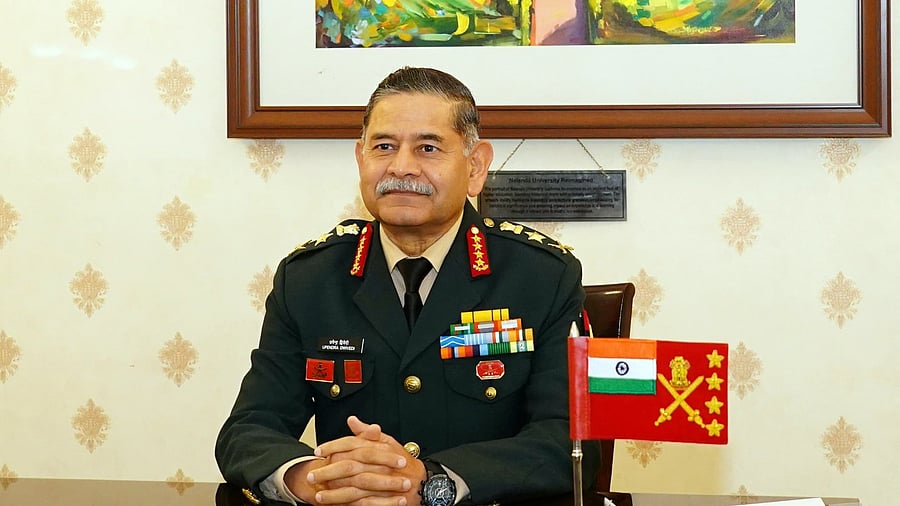
Chief of the Army Staff General Upendra Dwivedi
Credit: X/@adgpi
New Delhi: Indian Army was “all prepared for ground operations” during Operation Sindoor when Pakistan made the ceasefire offer after taking Indian troop positions into account, Chief of the Army Staff Gen Upendra Dwivedi said here on Tuesday.
He said that the Pakistan military never used nuclear rhetoric while talking to the Indian DGMO during the conflict.
On the situation at the northern front, the Army Chief skirted questions on troop reduction at the Line of Actual Control but asserted that though the situation at the LAC was stable, it needed constant monitoring as both sides were “trying to increase the trust factor.”
“The army's mobilisation (during Op Sindoor) to expand conventional space was such that if Pakistan made any mistake, we were fully prepared to launch ground operations,” Gen Dwivedi said, addressing the media ahead of the 78th Army Day.
In the 88-hour long conflict last May, the army expanded the space for conventional war, unlike a common perception that the space for conventional war was shrinking.
“The kind of firing that took place in Jammu and Kashmir, and the way we eliminated approximately 100 of their (Pakistan) personnel happened because we expanded the conventional space,” he said.
“There was no discussion on nuclear in the DGMO talks and whatever nuclear rhetoric was given was given by the politicians or given by the local public in Pakistan. I have no indication that anything of that sort came from the (Pak) military,” he said.
Following Op Sindoor, terror activities and infiltration attempts have come down in Jammu and Kashmir, but at least eight terror camps are still active: six across the Line of Control and the other two are opposite to the international border in Jammu region.
In the last two weeks, a number of drones were seen in Jammu and Kashmir – at least six were seen on January 10 and another two-three on Jan 11 and 12. These are possibly defensive drones that were sent either to check if any action was being taken against these platforms or to see if there are any gaps through which infiltrators can be sent.
“We had a DGMO (Director General of Military Operations) talk today. This matter was discussed in that talk, and they were told that this is unacceptable to us, and please put a stop to it. This has been conveyed to them,” he said.
In the wake of China once again issuing statements on territorial claims on Shaksgam Valley, the Army Chief said it was “illegal action” as India considered the 1963 agreement under which Pakistan ceded 5,180 sq km of area in the Shaksgam Valley in China as illegal.
“We don’t approve of any activity in the Shaksgam Valley. We don’t accept the joint statement which has been issued in China, what I understand about the CPEC 2.0. We consider it as an illegal action being carried out by the two nations,” Gen Dwivedi said.
Since the 1962 war, 38,000 sq km of Indian territory in Aksai Chin has been under Chinese control. Furthermore, 5,180 sq. km of territory was ceded by Pakistan to China following the 1963 ‘Boundary Agreement’ between the two countries.
India maintains that Shaksgam Valley is an Indian territory and the country reserves the right to take necessary measures to safeguard its interests.