
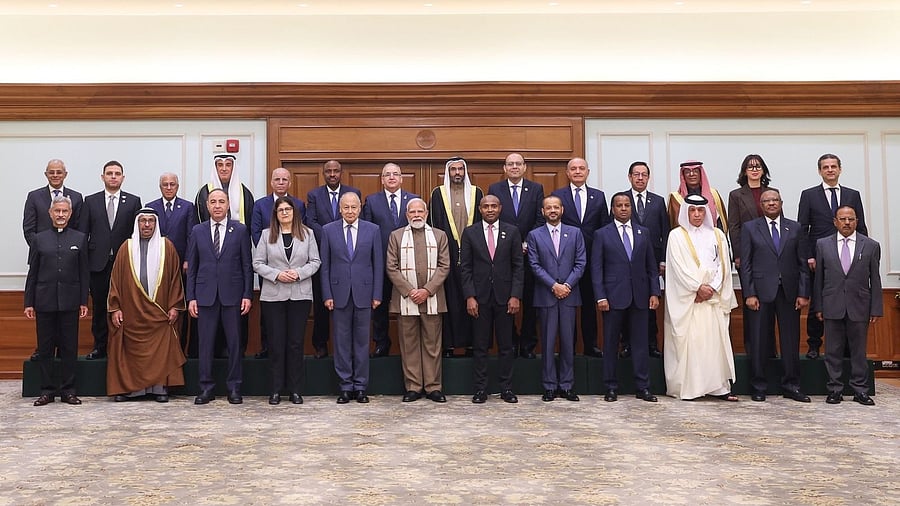
Prime Minister Narendra Modi with Foreign Ministers and delegations of the Arab League.
Credit: X/ @narendramodi
New Delhi: Ahead of his visit to Israel, Prime Minister Narendra Modi on Saturday reaffirmed India’s support for the people of Palestine and welcomed President Donald Trump’s plan to end the conflict in Gaza, despite turning down the invitation from the leader of the United States to attend the recent Board of Peace launch event in Switzerland.
The foreign ministers of the member nations of the League of Arab States called on the prime minister in New Delhi, ahead of their meeting with External Affairs Minister S Jaishankar.
Modi reiterated India’s continued support for the people of Palestine and welcomed ongoing peace efforts, including the peace plan for Gaza. He conveyed his appreciation for the important role played by the Arab League in supporting efforts towards regional peace and stability, according to a press release issued by the Prime Minister’s Office.
“The Arab world is a part of India’s extended neighbourhood, linked by deep civilisational bonds, vibrant people-to-people connections and enduring brotherly ties, as well as a shared commitment to peace, progress and stability,” Modi posted on X, adding: “(I am) Confident that enhanced cooperation in technology, energy, trade and innovation will unlock new opportunities and take the partnership to new heights.”
Ahmed Aboul Gheit, the secretary general of the League of Arab States, was with the Arab foreign ministers during the meeting with the prime minister.
They later attended the meeting of the second India-Arab Foreign Ministers, which Jaishankar and his United Arab Emirates counterpart, Abdullah bin Zayed bin Sultan Al Nahyan, jointly chaired.
Modi is likely to visit Tel Aviv on an invitation from Prime Minister Benjamin Netanyahu in the last week of February.
Varsen Aghabekian Shahin, the minister of foreign affairs and expatriates of the Palestinian Authority, was also among the foreign ministers who met the prime minister and attended the conclave hosted by New Delhi on Saturday. She recently suggested that India could play a greater role in mediating between Israel and Palestine, as well as in the reconstruction of the Gaza Strip.
India recently refrained from showing up at a ceremony held in Davos, Switzerland, on January 22 for the signing of the charter of the ‘Board of Peace’, a body envisaged by Trump as a global peace-making platform, beginning with the Gaza Strip – the scene of Israel-Hamas conflict since October 2023 – but extending to other hotspots around the world too.
“The situation in Gaza, in particular, has been the focus for the international community. Many of us were present at the Sharm-el-Sheikh Peace Summit in October 2025. This evolved into the UN Security Council Resolution 2803 of November 2025,” Jaishankar said in his opening remarks at the conclave with the meeting with the foreign ministers of the League of Arab States member nations. “Taking forward the comprehensive plan to end the Gaza conflict is today a widely shared priority. Various countries have made policy declarations on the peace plan, individually or collectively. This is the larger context in which we deliberate on the region’s challenges and prospects.”
Despite turning down an invitation from Trump to Modi to take part in the event at Davos, New Delhi, too, recently joined the European Union in noting the adoption of the UN Security Council Resolution 2803 of November 17, 2025, which welcomed the establishment of the Board of Peace and authorised an International Stabilisation Force, as outlined in the Comprehensive Plan, as a step forward to end the conflict in Gaza. India and the EU, however, encouraged all parties to implement the resolution in its entirety, in line with international law and relevant UNSC resolutions – thus tacitly advising Washington, D.C., against using the Board of Peace to bypass the international organisation or to project it as an alternative to the council.