
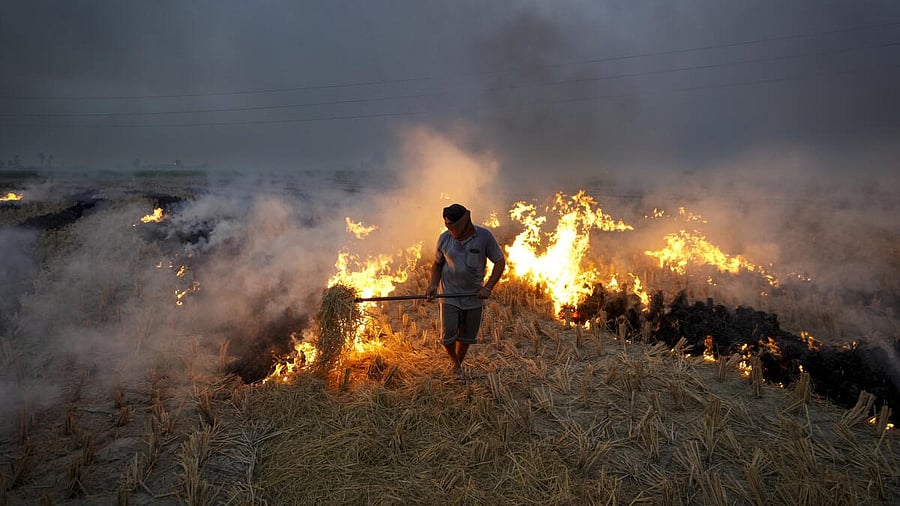
A farmer burns paddy stubble in a field on the outskirts of Amritsar.
Credit: PTI File Photo
New Delhi: Farmers in Punjab and Haryana have changed the time window to put their fields on fire in order to escape detection by satellites that keep a close watch on stubble burning, according to a new report released on Monday.
The time shifting began in Punjab after stubble burning reached its peak in 2021 and over 90% of large fire in the last two years happened after 3 PM. In neighbouring Haryana, a similar trend is seen since 2019, says the report by International Forum for Environment, Sustainability and Technology, a think tank working on green issues.
This is the second report with a similar conclusion in the last two weeks after scientists from ISRO’s Space Application Centre, Ahmedabad showed “a gradual shift in peak fire activity from 13:30 IST in 2020 to 17:00 IST in 2024, to avoid detection by polar-orbiting satellites.”
While official government data suggests a dramatic 90% decline in farm fires in Punjab and Haryana, the iFOREST report shows the reduction is largely due to the limitations in the current monitoring system that fails to capture the actual fire count.
The official fire counting mechanism run by the Indian Agricultural Research Institute relies on two sensors in three NASA polar satellites that pass over India between 10.30 AM and 1.30 PM.
“Satellite data we used show that the majority of large farm fires now occur after 3:00 PM, beyond the overpass times of polar satellites. More than 90% of large farm fires in Punjab in 2024 and 2025 occurred after 3:00 PM. In 2021, only 3% of large fires occurred after this time,” said Chandra Bhushan, Chief Executive Officer of iFOREST.
“In Haryana, most large farm fires have taken place after 3:00 PM since 2019, underestimating fires in Haryana for several years.”
Scientists at SAC drew a similar conclusion after analysing the fire events between 2020 and 2024. In 2020, fires typically ignited around noon, peaked near 13:30 IST, and subsided by 15:30 IST, giving enough time to the satellites to pick up the signals.
“We observe a gradual temporal shift between 2021 and 2024, with peak fire activity occurring around 17:00 IST in 2024. At the same time, the diurnal window of fire activity narrowed substantially, suggesting an informed adjustment by farmers to avoid detection by polar-orbiting sensors,” the SAC researchers reported in the Nov 25 issue of Current Science.
Over the years there has been 35-25% reduction of stubble burning in Punjab and Haryana that can be estimated from burnt area mapping. The decrease, however, doesn’t commensurate with the official data that present a wrong picture because of inaccurate fire count figures.
“The Decision Support System for air-quality management in Delhi, run by the Indian Institute of Tropical Meteorology should revise its methodology to more accurately quantify the contribution of stubble burning to air-pollution loads in Delhi-NCR,” Bhushan said, adding that the IARI should begin monitoring burnt-area data to provide a comprehensive and accurate picture of stubble burning across India.