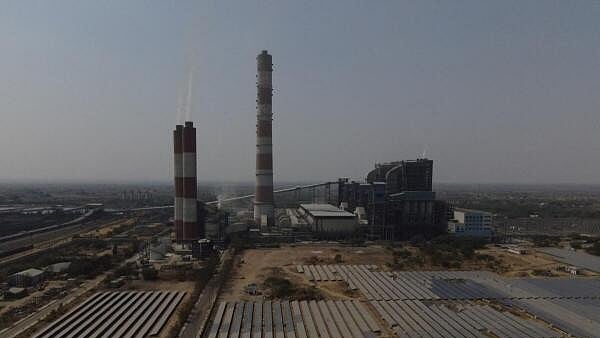
Representative image of a thermal plant.
Credit: PTI Photo
Mumbai: India can secure reliable, round-the-clock clean power at costs competitive with new thermal plants by 2030 under realistic market conditions, with the possibility of achieving cost parity as early as 2025 under more favourable circumstances, according to a new report.
The study, Budgeting for Net Zero: Powering India’s Reliable Clean Energy Future by the International Institute for Sustainable Development (IISD) and the Center for Study of Science, Technology and Policy, finds that firm and dispatchable renewable energy (FDRE) - hybrid projects combining solar, wind, and battery storage - can match or undercut the cost of new thermal power plants when developers are able to monetise both a portion of surplus electricity generated by oversized renewable sources and additional storage capacity.
FDRE projects install slightly more renewable and storage capacity than required for their contracted supply; selling this surplus power plays a critical role in lowering overall costs.
FDRE - one of several types of tenders for firm clean energy - is already much cheaper than new coal when the full social costs of thermal power plants are considered.
Without accounting for social costs, the study identifies three cost-parity timelines, depending on how much surplus power developers can sell into the market: 2025 when 100 per cent of surplus power is monetised, 2030 when 50 per cent of surplus power is monetised, and 2047 when only 30 per cent of surplus power is monetised.
“Firm and dispatchable renewables are not just a clean alternative—they are an increasingly competitive source of reliable power. With thoughtful tender design and market reforms, India can tap into FDRE to meet rising electricity demand, cut long-term costs, and build a power system that is both resilient and future-ready,” said Sunil Mani, policy advisor at IISD.
The study examines when and under what conditions FDRE can compete with new thermal, whether government support is needed to accelerate deployment, and the macroeconomic impacts of scaling FDRE. It also evaluates how tender design, developer strategies, and electricity market reforms influence FDRE’s affordability.
The report stresses that FDRE is not meant to replace all other clean energy solutions. BecauseFDRE guarantees firm delivery, it is naturally more expensive than standalone solar, wind, or storage when round-the-clock supply is not required.
The authors of the report highlight that a balanced approach - deploying FDRE where demand profiles justify it and expanding lower-cost clean energy and storage elsewhere - will deliver the most efficient outcomes for India’s evolving power system.
“FDRE can play an important role alongside standalone renewables, storage, and smarter grid management to support India’s clean energy transition,” says Dr Anasuya Gangopadhyay, senior associate in the Climate Change Mitigation team at CSTEP.