
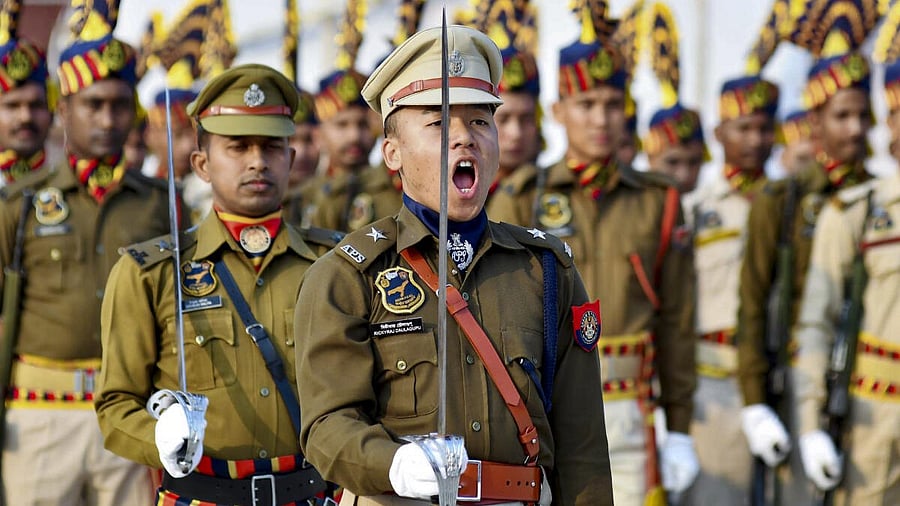
Security personnel march during the full dress rehearsal for Republic Day Parade 2026.
Credit: PTI
When the horses of the 61 Cavalry will lead the Presidential cavalcade in the morning of January 26, many among the audience may not realise that it will also be a swansong for the South Block housing the ministries of Defence and External Affairs, and the Prime Minister’s Office. This will be the last time the occupants of the historic building will play the central role in shaping the contours of the Republic Day parade, linked to India’s present and future policies.
The process of shifting the Defence Ministry, the last occupant of the South Block, will begin a few days after the parade and the Beating Retreat ceremony on January 29 while the armed forces – Army and Navy – may be given some more months for the shift as the process involves moving their equipment too.
Of the Big Four sitting atop the Raisina hills, the Ministries of Home Affairs and Finance have already shifted out of the North Block while almost the entire External Affairs Ministry and the PMO have vacated the South Block.
After a century, the curtains are being pulled down on the North and South blocks that are to be converted into Yuge Yugeen Bharat National museum.
The Britishers inaugurated the Secretariat – comprising the two magnificent buildings - officially in 1931 but the two administrative blocks began functioning in 1926.
According to historian Swapna Liddle, work on the Government House (now Rashtrapati Bhawan) and the two secretariat buildings began same time, but with a delay in the supply of red sandstones from Dholpur, the limited stone was diverted to the construction of the Secretariats at the cost of Government House.
“As a result, work on the Secretariats progressed well, and in 1925, several departments started moving into the buildings. By November 1926, the Secretariat was fully functional within its new premises, even though the domes were yet to be built. The buildings were finally completed only in 1930,” she wrote.
The two blocks were constructed as a part of rebuilding a grand new city in Delhi after the British government decided to shift the national capital out of Calcutta following the massive political unrest triggered by Bengal partition.
Architects Edwin Landseer Lutyens and Herbert Baker toyed with various ideas to create the new seat of power, some of which were rejected (including extending the Kartavya path to Jama Masjid and having palaces of Maharajas on both sides of the central boulevard) but the idea of having two grand secretariat buildings on both sides of the Government House (used as the house and office of the Viceroy) received the nod.
To give an external semblance of Indianness, the architects chose to widely use sun breakers (chajja), a latticed window (jali), and the dome which they called the chattri.
The construction work was spearheaded by a number of Indian contractors. Among them were Sobha Singh, father of editor and author Khuswant Singh, who got the contract to build the South Block. His friend Basakha Singh received the contract for the North Block.
“In front of our shack, ran a narrow gauge railway track from the village of Badarpur, about 12 miles south of Connaught Circus. It had been laid to bring stone, gravel and rubble from Badarpur to the building site,” Singh wrote in his autobiography (Truth, Love and a Little Malice). Huge sheds housing the stone-cutting machines and masons sculpting the stones into patterns were set up in front of his house. On Sundays, once the railway coaches emptied the materials in the sheds, the railway officials used to give children a free ride to Connaught Circus and back.
Khuswant said the first task of his father was to carry two foundation stones, laid by King George V and Queen Mary in 1911 after the coronation durbar, to the Raisina hills. It was done at night. “He hired a bullock-cart, packed the stones in it and rode on his bicycle alongside through the city suburbs in the light of petromax lamps, and implanted the two stones of what was to become the capital of India.”
The two blocks seamlessly transitioned into the seat of power in independent India in 1947. They remained silent witnesses to modern India’s changing history: from decades of Congress rule to the imposition of emergency to the rise of Hindutva politics.
The strategy behind India’s most emphatic military victory in 1971 was scripted inside the high-ceiling walls of the South Block. On the other side of the road, Finance Minister Manmohan Singh crafted a historic budget in the North Block maintaining great secrecy till Singh concluded his speech in Parliament, quoting Victor Hugo: “No power on earth can stop an idea whose time has come.”
From the implementation of Mandal Commission’s report and demolition of Babri Masjid to heli-dropping of troops on the Siachen glacier and countering Pakistan’s misadventure into Kargil heights, lights burned late into the night in the offices in North Block and South Block in numerous occasions.
Even the sprawling new museum may be short of space to keep all the nuggets of history buried inside the corridors of power.