
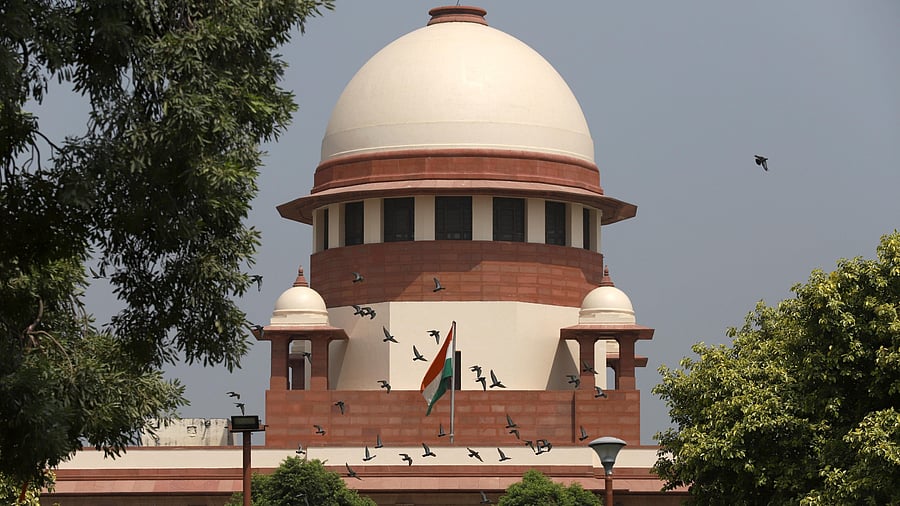
The Supreme Court of India.
Credit: iStock Photo
New Delhi: The Supreme Court has said that the reservation roster can't be used as the basis for a selection process as a reserve category candidate with higher cut off marks is to be treated as having qualified against an open or unreserved vacant post.
A bench of Justices M M Sundresh and Satish Chandra Sharma held that the reservation roster is used only to define number of vacant posts for future recruitment.
"Since reservation register or roster defines the quota available for recruitment, it can be used to decide who deserves selection and who does not deserve selection on account of a concerned category quota being filled by more meritorious candidates in the category available for the concerned candidate," the bench said.
The bench highlighted mainly two-fold purposes of maintaining reservation register or roster, firstly, to ascertain that any given point of time, the number of employees in a cadre belonging to a particular category (SC, ST and OBC) does not exceed their lawful quota in the cadre. The second is to determine the number of posts in all the categories (UR, SC, ST and OBC), vacant for future recruitments.
Allowing an appeal by Airport Authority of India (AAI), the court set aside the Kerala High Court's division bench judgment of February 19, 2020. The HC directed for appointment of respondent Sham Krishna B to the post of junior assistant (fire service).
The HC directed the AAI to ensure that roster points are filled in accordance with the model roster in the Office Memorandum issued by the Department of Personnel and Training on July 02, 1997.
The apex court, however, found, the High Court failed to appreciate the fundamental fact that the reservation roster comes into picture only after selection process is over and a reservation register or roster is a list of employees of a cadre, who are on the payroll of the organisation after joining their duty.
The bench referred to December 19, 2025 in case of Rajasthan High Court & Anr Vs Rajat Yadav & Ors, in which the Supreme Court declared that a candidate belonging to reserve category who has scored higher marks than the cut off marks for the general category candidates has to be treated as having qualified against an open unreserved vacant post.
In the present case, the bench pointed out, no concession or relaxation was extended to the reserve category candidates who have been appointed on their own merit against the posts meant for the general category candidates as they have scored more marks than the general category candidates.
The court also noted that all the vacancies notified for unreserved category i.e. 122 posts were filled up based upon the marks scored by candidates in the process of selection on their own merit.
"Therefore, the appellant authority were justified in migrating the candidates belonging to reserve category to the unreserved list on the basis of their own merit as they have scored higher marks than the general category candidates," Justice Sharma wrote in a 28-page judgment on January 16, 2026.
The court held, there can be no question of directing appointment of respondent, Sham Krishna B or any other person belonging to unreserved category as all vacancies notified under the unreserved category have been filled strictly in accordance with the merit list.
In terms of selection process initiated against 2013 advertisement, appointments were made only to 158 candidates against 245 notified vacancies.
The first respondent, having not been selected under the unreserved category approached the High Court, which held that appointments were vitiated because only 158 candidates had been appointed against 245 notified posts, and the reservation policy had not been correctly applied.
The division bench also held that the appointments had been erroneously made and that the roster had not been properly applied.