
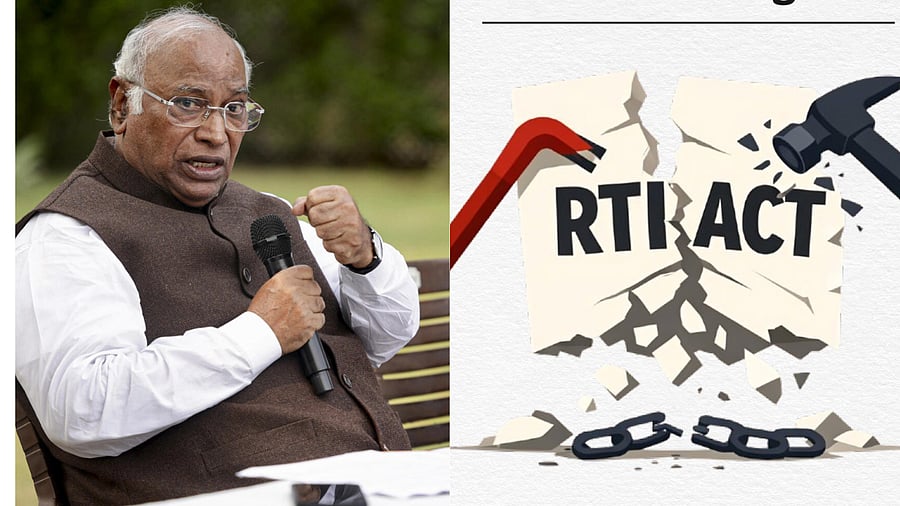
Congress chief Mallikarjun Kharge
New Delhi: The Economic Survey's prescription for a “re-examination” of the RTI Act by exploring possibility of a “ministerial veto” to withhold information and exempt confidential reports and draft comments from disclosures have attracted criticism from the Congress and transparency activists who insisted that there is "no evidence" to suggest that officers are restricted because of the existing law.
The survey said the RTI Act was "never intended as a tool for idle curiosity, nor as a mechanism to micro-manage the government from the outside" but warned that the existing transparency regime "may hold back" officials to express their views freely and instead resort to "cautious language and fewer bold ideas", as "candour needed for effective government is blunted".
Tabled in Parliament on Thursday, the survey quoted the restrictions provided in the transparency laws in Sweden, United States and United Kingdom to argue for similar provisions in the RTI Act, while insisting that it is "not an argument for secrecy by default".
"Nearly two decades on, the RTI Act may need re-examination, not to dilute its spirit, but to align it with global best practices, incorporate evolving lessons, and keep it firmly anchored to its original intent. A few possible adjustments may be worth exploring," it said.
It suggested exemptions for "brainstorming notes, working papers, and draft comments until they form part of the final record of decision-making", protecting service records, transfers, and confidential staff reports from casual requests that add little value to the public interest and a "narrowly defined ministerial veto, subject to parliamentary oversight, to guard against disclosures that could unduly constrain governance".
The Economic Survey also suggested a possible "Ministerial veto" to withhold information and wants to explore the possibility of shielding public service records, transfers and staff reports of bureaucrats from public scrutiny.
Congress president Mallikarjun Kharge posted on 'X', "Modi government has systematically weakened the RTI Act...After killing MGNREGA, is it RTI's turn to get murdered?" even as he referred to pendency of RTI appeals, "conversion of the independent watchdog to submissive functionaries" and "weaponising privacy to shield corruption and stonewall scrutiny".
Anjali Bhardwaj, associated with Satark Nagrik Sangathan and the National Campaign for Peoples’ Right to Information, debunked claims of constraints faced by officers saying they survey makes such statements "without providing any evidence". She said Section 8 and 9 of the RTI Act already give adequate protection against disclosure though it is being misused to deny information.
Bhardwaj referred to similar attempts during the UPA government but it could not go ahead with it as it failed to provide any evidence, even as she emphasised that countries like Sweden among others are way ahead of India in proactive disclosures. She told DH, "we call ourselves the mother of democracy. Then, why shy away from providing information to people?"
Venkatesh Nayak, Director of Commonwealth Human Rights Initiative (CHRI), recalled that the BJP was vocal in opposing the proposal to restrict the RTI during the UPA era.
The UPA Govt had crafted an amendment proposal along similar lines in 2006 but could not muster enough support to table it in Parliament. The NDA, particularly, the BJP was most vocal in opposing the move along with civil society.
"The idea of ministerial veto over disclosure is also not a new one. Several Commonwealth countries like the UK, Australia, New Zealand and even Scotland have such provisions in their freedom of information laws. But have been used rarely and even when used, they are subject to strict judicial review," he said.